



Deep Mountain: An Interview with Ece Temelkuran
Ece Temelkuran’s latest book Deep Mountain: Across the Turkish-Armenian Divide explores the history and continuing discussion surrounding the Armenian Genocide in Armenia, Turkey, France, and the United States. The project, which was borne from conversations the author had with Hrant Dink, the late editor of Agos newspaper, probes deeper into this situation by interviewing a wide range of Armenian writers, thinkers, and activists including Armenian poet Silva Gaboudikian, musician Arto Tuncboyajian, and filmmaker Serge Avedikian.
A well-known journalist and political commentator in Turkey, Temelkuran writes regularly for the Turkish newspaper Haberturk and has won numerous awards for her work, including the Pen for Peace Award and Turkish Journalist of the Year.
Temelkuran sat down with Taleen Babayan for an interview about Deep Mountain, which was recently translated into English by Verso Books.
***
Taleen Babayan: You interview so many amazing and influential people in this book—politicians, musicians, students, lawyers, and businessmen—including Arto Tuncboyajian, Silva Gaboudikian, Patrick Devejian, Vartkes Yeghiayan. And they each have their own way of looking at not only the Turks but at themselves as Armenians. Was there a common thread among your subjects and the people you spoke with?
Ece Temelkuran: Although they expressed it in completely different ways, the main question that was eating them was this: Why don’t Turks feel anything? Even Ara Toranian [editor of Nouvelles d’Arménie Magazine and alleged former ASALA member] wants to tell his story to the Turks, not to the French or Americans. But the one who he wants to tell the story to doesn’t want to listen. I think, although the Armenian community is extremely mature, they have this wounded child in them, whatever their ages are. That is the common thread I guess.
TB: You interviewed French politician Patrick Devedjian, who was the architect of the genocide bill in France, which had an amendment that would criminalize the denial of the Armenian Genocide in France. He felt Turkey would change under heavy pressure, and you felt the opposite—that this kind of legislation would cause Turkey to retreat and make it more difficult for open dialogue to ensue. Do you still hold this viewpoint? Don’t you think the recognition of the genocide by the world will cause Turkey to finally face its past since the rest of the world is doing so?
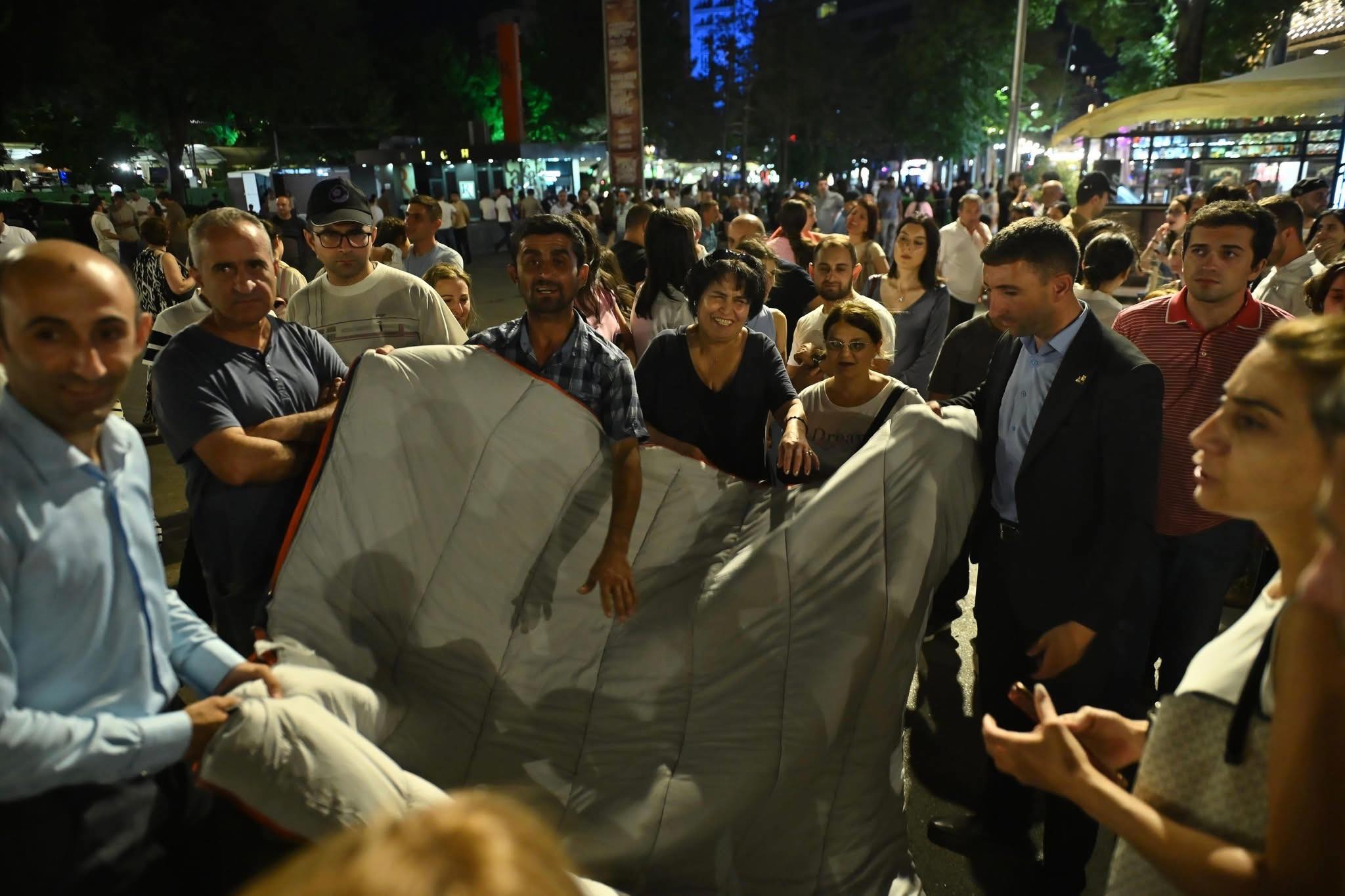
ET: There are two levels of this issue. One of them is the diplomatic side. Of course Turkey will change under diplomatic pressure, and it started changing as we all witnessed recently. We have seen the Turkish prime minister and the Armenian prime minister shaking hands and two foreign affairs ministers signing protocols. Behind them were the world leaders, as if these politicians were the children and the leaders of the world were the parents who are guarding them. But this is not real. It’s something artificial. When people don’t feel it within them, it doesn’t matter if diplomatic progress has been made. If the peoples on both sides aren’t genuinely integrated to the process the diplomatic progress can be easily sabotaged. After Hrant [Dink] died, Armenians became an easier topic to talk about [in Turkey]. His death became a human shield on the issue. People even created the slogan ‘We are all Armenians’ in his funeral. I always feel as if Hrant was sacrificed. After his death, it became relatively easier for people to talk about Armenian issues and openly say they have Armenian friends. It’s tragically ironic. Even the diplomatic progress would be completely impossible without what people felt after Hrant’s death. Bottom line is, Hrant has done more than any world leader or any legislation could do.
TB: How has the reception been for Deep Mountain amongst both Armenians and Turks? Was it written for an Armenian audience?
ET: It was received very well in Turkey, to my surprise. The book sold over 60,000 copies and [that is a high number] for a country like Turkey, which clings to amnesia. I think it was because of the attitude of the book. In most cases, intellectuals are trying to push and slap this issue into people’s faces. They expect people to feel guilty rather than remember. I tried to make them remember first and then leave it to them to figure out what they feel about it. Most of the people felt not necessarily guilty but touched for the first time, and without even questioning what really happened in 1915, they were eager to understand the humane side of the history. They admitted that they have feelings about Armenians which Turks are taught not to have. I guess, for the first time, Turkish people were trying to put themselves in the place of Armenians.
I wanted the audience, especially the Turkish audience, to put themselves in this character who in the beginning doesn’t feel a thing about Armenians, who rejects to feel anything, and who by time understands the reason of his/her numbness. I suppose that numbness is what intimidates Armenians most, and they have a point. They say, “We feel so much about this ancient conflict and you feel nothing. How come you feel nothing?” That’s the biggest question of the Armenians. That is why I wrote the book for both audiences, Armenians and Turks, just to create a new path of communication. Because there are Turkish people who feel for Armenians and there are Armenians who are not just furious.
TB: Have there been any consequences for you or your career since you wrote and published a book that discusses the Armenian-Turkish relationship and the Armenian Genocide?
ET: The positive reaction was more of a whispering, not out loud. Recently, a middle-aged woman stopped me on my way and said that she thought I was betraying my country and countrymen. I think that’s an exception because most of the people thought that this book tells the true stories of people. Deep Mountain was never after proving some historic reality, or never took a side in the genocide discussion. It was more about a human story. The book is defending that we should share our stories before labeling the story, and if labeling the story is an obstacle let’s leave it aside and talk our minds. I got some threats of course but that is…you know, kind of daily life in Turkey.
TB: When was the first time you heard about the Armenian Genocide?
ET: Through Hrant. Even when you are exposed to it, somehow you don’t see it. It’s in front of your eyes and you don’t see it. Somehow when it comes to Armenians, you just stop thinking. And if you don’t want to really get involved in the subject, you don’t have to because you can’t find information about Armenians. It’s not easy to blame Turkish people about not knowing about 1915 because there are no sources that are out there and legal in Turkey.
TB: One of my many favorite lines in your book is, “A true journey doesn’t answer a traveler’s questions. A true journey changes the traveler’s questions.” How long did this journey take you? Is it still continuing? And how did your questions change over time?
ET: Hrant was killed and that changed everything, for not only me but his family, friends, and the Turkish people. For the first time, they saw that this Armenian was an amazing man, so it changed all of our questions. But on the other hand, after his death, after I finished the book, my journey continued. He was killed because he was Armenian, that’s for sure. But there’s something else. He was a friend of mine. And all of a sudden you see that a normal friend of yours is killed and has turned into a symbol and someone you can’t define. So it changed my life in that respect as well. It was the first time I saw a friend dying. I saw him when he was lying on the ground in the street. So it changed a lot. But then it became like keeping a promise because he wanted me to write this book and he wanted the diaspora to read it. It was a promise to him.
TB: In the postscript of Deep Mountain, you apologize to the Armenians and invite them to have a glass of raki with you and to visit Turkey. Don’t you think this is a bit idealistic?
ET: That’s what Hrant was after, and I know there are people who take it seriously, which I would love to see. And there are homes of Armenians in Istanbul so they should really come. Even if it sounds idealistic or naive, I feel that it’s important for Diasporan Armenians to hear this from Turkish people. What’s done is done but the current psychological problem is feeling homeless, in a way, even for those wealthy Armenians with big estates in the U.S.
TB: In your opinion, what does the future hold for Armenians and Turks? You said in your book that neither the Turks nor the Armenians are homogenous. With this many different viewpoints, will there ever be a resolution? Will there ever be reconciliation?
ET: I think there will be. There is a crack in the wall of numbness. We cannot go back. There is a new wave now in Turkey among Turkish people. They are talking about finding their Armenian roots. It’s everywhere and people are happy about this. It is interesting to observe this new, deep wave. Since Hrant died two years ago, people are searching for their Armenian roots.
TB: You encountered many Armenians while you were writing this book. How did the process change your ideas of Armenians?
ET: People in Turkey are brought up with the idea that there is a giant monster called “diaspora” and then there are “our Armenians.” It is mostly believed that “the monster” is doing the evil (bringing up the recognition issue, etc.) and that “our Armenians” are actually “well behaved” enough to forget about what happened in 1915. After speaking to the Armenians abroad, I came to know and actually wrote about how deceiving this perception was. Most of all, seeing that all those “furious Diaspora Armenians” were actually the ones were most easy to talk to made me think about the “heart of the Armenians.” I thought about this especially when I talked to Ara Toranian in Paris. Over all, I never knew that the Armenians, even those whose fathers were born in the U.S., missed Anatolia with such passion. I think the Turkish audience was most touched by this reality. Speaking to the readers in Turkey, I can say that Deep Mountain changed the image of the diaspora in Turkey in every sense.
TB: While conducting your interviews and research for Deep Mountain, you spent time in France, the U.S., and Armenia and got to know the Armenian communities there. Do you now see a difference between Armenians in Armenia and Diasporan Armenians in terms of how they perceive Turks?
ET: As you go West, the subjects I met became less emotional, I can say. Such generalizations never represent the whole truth, though. Yet, again I can say that in Europe the issues of memory, 1915, and dialogue are more intellectualized. As for Armenia, I observed an eagerness to “forgive” Turks, even though there has been no apology. I even heard a couple of Armenians in Yerevan saying this: “It wasn’t the Turks, it was Jews who killed the Armenians.”
TB: As someone who knew and respected Hrant Dink, what do you think people should do to honor his memory?
ET: Rather than proving that they were killed, Hrant wanted to prove that the Armenians actually lived in Turkey. So I think putting this reality forward might be the first thing to do. Besides, he was saying that “We should learn to talk about today, and then we can find a way to talk about the past.” That is why I tried to describe the Armenians and Turks of today, rather than going to the archives. This is an attempt which requires a collective effort. I hope Deep Mountain can help us start a journey together that Hrant long dreamed of and sacrificed himself for.
For more information about Ece Temelkuran and Deep Mountain, visit http://en.ecetemelkuran.com.

I am from Turkey and this is one of the two books (the other one is Fethiye Çetin’s Annneannem-My Grandmother) that i recommend people around me who started to grow an interest in the Armenian issue -or at least have the potential to do so. I read it a couple of times. As Ece stated, Turks usually stops thinking and feeling when it comes to Armenians. This book provides a good analysis of this state of apathy. I have never really been a hater of Armenians despite all the brainwash we are subjected to spanning from the early childhood to the history classes at high schools. but this book truly helps getting to know and understand the Armenian diaspora enough to make a fresh start in your mind.
I have been following Armenian weekly quite some time and never really felt ready to post a comment until now. To be honest, this is because I didn’t think i could handle the reactions i was to face here for just being a Turk. I thought it was time, because this is a special book.
Thanks for sharing Burak.
“The book is defending that we should share our stories before labeling the story,”
Guys, this ‘sharing of stories’ will consist of: “You suffered, we suffered. Let’s call it even.” Rubbish. Yellow journalism by Temelkuran.
Burak ,
It is good to know you have reading habit.
How many books did you read about the period 1900-1918 ?
“As Ece stated, Turks usually stops thinking and feeling when it comes to Armenians”
Who gave the right to you to speak on behalf of a nation ?Please talk for yourself.
It is so suprisingly that you understood the mentality of Hays after reading only a book ..Looks like you are ready for “human right activist”, or “nobel prize” …
Ha ha ..you are so late..There are many already out there ..Old fashion…
We need more intellectuals and consciously sensitive, bright writers like Ace Temelkuran.
I recently read Deep Mountain. I am appreciative of Temelkuran’s relatively sensitive approach, as well as the mere fact that Turkish authors are willing to explore Armenian perspectives, which are new to Turkish audiences, and very important to the Armenian people. However despite the book’s acclaim and my appreciation to the author for being willing to explore this difficult socio-geopolitical issue, it ultimately falls short of progress in two key areas.
For one, the term, genocide, never appears outside of quotes, opting to use ‘1915’ in its place. Perhaps this is a requirement of any book on the subject matter to be published in Turkey, in which case represents capitulation to the autocratic government party line, despite the author’s criticisms of the Turkish government more generally throughout her career. This is fundamentally flawed and ironic given that the book highlights a key Turkish-Armenian relationship in Boston (as a symbol of progress for both communities) where genocide recognition is the key tenet to growth and reconciliation! By failing to use the work genocide outside of quote marks, the author has undermined her own position by either consciously or unconsciously accepting Turkish authority on the matter. The author’s regular use of the term ‘Armenian Issue’ follows the same line, where the global effort of diaspora Armenians and silenced Turkish-Armenians is not a struggle for recognition of our pain and need for factual documentation of recent history, but rather something which is bothersome to the Turkish state in advancing political goals like EU acceptance or domestic minority population control.
The second key flaw is that the author asks of each Armenian interviewee “don’t you ever get tired of the ‘genocide issue'”, to which there are two main general answers of, “of course, but we will never give up” and “no, we will never give up until XYZ…”. To reduce the needs of the Armenian community to a chore, is to ask a person if they are tired of “washing themselves”. While the author learns to view Armenian psychological trauma over genocide recognition and discussion as critical to the identity of Armenians and ultimately finds a source of Turkish psychological trauma stemming from the same root, we are left with a question for the author, “dont you ever get tired of suppressing guilt passed down over generations?”. Hopefully in the author’s journey their questions to themselves may change.
While I dont see it as a fatal flaw to the book, perhaps a great deal more can be learned from publication of the dialogue between the author and Zaven Manikjian, in which only the line “Journalists are for sale. And Turkish journalists come cheapest of all!” is produced. While not to allow the poor behavior on anyone’s part, an aggrieved Armenian raised in fear of Turkish people (as the book explores in many interviews) is an obvious source of spite and rage. It is not surprising to find ‘bad eggs’ in the Armenian community, but what is surprising is that the author did not allow the audience a view at what words or concepts can upset a Turkish intellectual. The author finally expresses a strong emotional reaction despite years of work confronting the ‘unfeeling’ nature of the Turkish perspective on the matter, and instead complains about the shallowness of Los Angeles or its ‘maze-like’ geography.
Perhaps as an Armenian, I am particularly critical of any Turkish writing on this topic. However, when speaking with Turkish people in my community, mostly secular, engineers, artisans, and journalists, the term ‘genocide’ is not a controversial term, so long as the term can be applied to Jews, Rwandans, Rohingya, etc, and is not unique to the Armenians, thereby effectively absolving the millennial and youth generations of Turks of the crimes of previous generations, merely by accepting a historical fact. I greatly appreciate insight and the willingness of Turkish people everywhere for discussing this fork in the road where our cultures and histories divide.