



Barsoumian: Turkish TV Program Suspended for Comments on Genocide
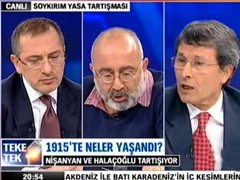
At 8 p.m. on July 13, television viewers in Turkey who tune in to watch Haberturk TV station’s “Teke Tek” (“One to One”) debate show will instead see a program prepared by the Turkish state’s television and radio monitoring agency, the RTUK.
Teke Tek was recently penalized by the RTUK for comments made by Sevan Nisanyan on the topic of the Armenian Genocide. The episode in question aired on March 9, less than a week after the U.S. House Foreign Affairs Committee passed the Armenian Genocide Resolution.
Teke Tek is a debate program hosted and moderated by Fatih Altayli. The two guests on the March 9 episode were Yusuf Halacoglu, the former president of the Turkish Institute of History and a notorious genocide denier, and Sevan Nisanyan, an Armenian-Turkish linguist, writer, and lecturer, and columnist for the Turkish daily Taraf and Armenian Agos newspapers. Nisanyan recently published a book titled The Country that Forgets Its Name, a study on around 30,000 place names in Turkey and their Turkification.
During the March 9 debate, Nisanyan said, “Terrible events happened in 1915. A whole society who had been living here for thousands of years was expelled from their home country and was subjected to tyranny and injustice. … The state policies in Turkey say that this is a lie and that they do not care about our feelings. I think these policies have softened a little throughout the past two to three years. At least, they stepped back from completely ignoring it. But when we look at recent speeches of the government, we see very clearly that the basic mentality has not changed.”
Nisanyan’s comments were, according to the RTUK, overly critical and “humiliated the Republic of Turkey.” The RTUK decision to fine the station and cancel the July 13 showing of Teke Tek was made on June 15 (June 16 by some accounts) and Haberturk was informed of it on June 21. The notification of the punishment was signed by Arslan Narin, the RTUK’s legal advisor.

According to the Turkish bianet.org, which monitors and covers media freedom issues in the country, the July 13th program by the RTUK will be preceded by an announcement and explanation of Teke Tek’s suspension, along with the display—at 10-minute intervals—of the official laws that have been broken.
The RTUK cited Article 4(i) of Law No. 3984 and No. 4756, which forbid broadcasters to “exceed the limits of criticism and insult an institution,” and which, according to Reporters Without Borders (RSF), is worded in such a vague manner that it allows officials to draw “subjective—usually ultraconservative—interpretation that prevents Turkish society from tackling vital issues.”
Habeturk has the right to appeal the case with the Administrative Court.
Nisanyan responds
The Armenian Weekly asked Nisanyan to share his reaction to the RTUK’s decision. “The Turkish Old Guard is desperate,” he said. “There is whole regiment of mostly elderly apparatchiks who are simply shocked by the changes taking place in the country, and they are reacting in mostly incoherent and irrational ways.”
“The program I took part in would be simply unimaginable in this country two years ago. Now most people, especially of the younger generation, find it perfectly acceptable and interesting, while the Old Guard rants and raves and foams at the mouth. One cannot blame them. Their world is collapsing around them.”
Nisanyan said he didn’t have any hesitation when accepting to be on the show. “I only regret I wasn’t as sharp and combative as I could be on that program. I would probably take a stronger stand if I were invited again,” he said.
Haberturk responds
On Thurs., June 24, Haberturk, which also publishes its own newspaper, responded to the punishment in an article. The decision, it said, shows that the RTUK thinks the moderator should disprove the ideas presented by his/her guests, even during intellectual discussions, and sees the failure to do so as a breach of the principles of publication.
The article also stated that the RTUK is banning the airing of the program because of Nisanyan, who is not a representative of the Armenian lobby and is a Turkish citizen, and a known figure whose views have been published in the books he has authored.
Over 150 readers commented on the article. One disgruntled reader wrote, “This is what AKP’s democracy is all about! Let everyone shut up and only we are going to talk! You only listen and give us your votes.” Another wrote, “I believe the RTUK should make a decision to remove from the map the countries that accept the Armenian position.” While another wrote, “I had watched this program. Nisanyan spoke in such a ridiculous way that I lost my mind. I kiss the hands of Yusuf Hodja. There wasn’t anything worth discussing because [Nisanyan] was conveying ideas that were entirely from a fantasy land. But Yusuf Hodja was giving the proper responses.”
Some simply wrote, “Shame on the RTUK,” and some expressed the view that if Nisanyan was saying anything wrong, there were people on the panel to respond to him, and that there was no need for such steps to be taken by the RTUK.
Reporters Without Borders condemns punishment
In a June 29 statement, Reporters Without Borders condemned the RTUK’s decision, stating that “[it] regards this disproportionate punishment as censorship pure and simple, and calls on the RTUK to rescind the decision.” Reporters Without Borders said it “regret[s] that a regulatory body should assume it has the right to decide the terms in which an historical event can be discussed.”
About RTUK
The RTUK was founded in 1994 to monitor and regulate television and radio broadcasts. The agency, which is headquartered in Ankara, has nine members who are elected by the Grand National Assembly of Turkey. It also has local offices in Istanbul, Izmir, Adana, Diyarbakir, and Van. Since its establishment, the agency has been responsible for closing down stations that have allegedly aired separatist propaganda.
A new law has also placed the internet under the watch of the RTUK. Service providers, websites, and users now fear tighter control and increased reprisals.
Media censorship in Turkey
In recent reports,* Turkey has been called a relentless suppressor of freedom of speech and one of the worst offenders of cyber censorship, along with Iran, North Korea, and at times China. Retaliations against broadcasters, journalists, and writers—from the authorities, individuals or groups—are also frequent in Turkey. In a 2010 report, Reporters Without Borders said there is a special hotline for reporting forbidden online material, and that between October 2008 and May 2009, the number of calls rose from 25,000 to 80,000.
Columnist and poet Ataol Behramoglu is facing a possible sentence and fine of 20,000 lira (~12,576 USD) in damages to Prime Minister Recep Tayyip Erdogan for criticizing the Justice and Development Party (AKP) during a program on CNN Turk on Jan. 2. On June 9, the Ankara court rejected Behramoglu’s lawyer’s argument that since the comments were made during a debate show as a response to the question “Are we going towards democracy or dictatorship?” they were protected under the right to free expression.
The latest eyebrow raiser is Turkey’s ban on some Google pages for the company’s refusal to remove clips off the video-sharing website YouTube.com, which is owned by Google, Inc. Some of the offending clips shed an unfavorable light on Mustafa Kemal Ataturk, who is viewed as the father of modern-day Turkey. In 2008, authorities in Turkey banned access to YouTube and in June 2010, they blocked access to Google pages that shared the same IP addresses as YouTube. Google offered to block the “offensive” YouTube clips in Turkey, but this was rejected by Turkish authorities who demanded their complete removal from the site. Turkey has also accused the company of registering in Turkey and paying local taxes.
Meanwhile, in May 2010, under Articles 314-3 of the criminal code and Article 7-2 of the anti-terrorist law, authorities convicted the editor of Turkey’s only Kurdish daily newspaper, Vedat Kursun, giving him a sentence of 166.5 years in prison for 103 counts of spreading terrorist propaganda for the Kurdish Workers’ Party (PKK). Most recently, the newspaper had published an article in which it referred to the PKK’s jailed leader, Abdullah Ocalan, as “the Kurdish people’s leader.” Ozan Kilinc, who took over as editor after Kursun, was himself sentenced to 21 years and 3 months in prison on Feb. 10.
The weekly Turkish-Armenian newspaper Agos has faced both brutality and harassment. In 2007, its editor, Hrant Dink, was fatally shot by a 17-year-old Turkish nationalist extremist.
Dink had been prosecuted three times for “insulting Turkishness” and received numerous death threats. In February 2010, the newspaper’s website was hacked, reportedly by individuals who admired Dink’s killer.
Endnote:
*Richard Howitt, a British member of the European Parliament and advocate of Turkey’s European Union membership, has warned Turkey that it cannot be considered as a serious candidate to the EU as long as the internet continues to be censored in the country. Howitt said the ban puts “the country alongside Iran, North Korea, and Vietnam as one of the world’s worst offenders for cyber censorship,” as reported by the Associated Press. Boston’s national public radio station, WBUR, noted that the censorship was being likened to ones imposed in Iran and at times China.

Great article, thanks. Is there any way we can see the debate online?
These words by Nisanyan give me hope:
“The program I took part in would be simply unimaginable in this country two years ago. Now most people, especially of the younger generation, find it perfectly acceptable and interesting, while the Old Guard rants and raves and foams at the mouth. One cannot blame them. Their world is collapsing around them.”
As Nisanyan points out, the old guard is feeling the pressure of a changing society and that frightens them. Now is the time for Armenians to keep the pressure up and not be deterred by reactionary suppressive moves. The truth is being recognized by more and more Turks who are horrified by it. Hrant Dink was truly a courageous man martyred for our cause.
Thank you for a very informative article but for some reason China was given some relief by the author where today China still has the same problems with the Google.
If one were to see the defamation via the disgusting deragatory remarks and statements made by Armenians and Greeks about a great man and leader (Ataturk), who kicked both of their butts, on YouTube, one would see WHY it wasn’t allowed to be shown there! If one had an internet version of YouTube which constantly defamed Armenian past heroes in Armenia, the same thing would occur. So cut the infantile hypocrisy already! As for the killer of Dink, recall the outpouring of people mourning his death in Istanbul alone! Can ANY of you dashnaks say the same reaction would occur if a Turkish journalist were killed in Yerevan? Of course not, otherwise dashnaks, or at the very least, the Armenian orthodox church, would have condemned the murders of innocent people around the world by Armenians during the 1970’s all throughout the late 1980’s! Yet just one more example of dashnak hypocrisy in action!
does anyone know where the book refered to in the article, The Country that Forgets Its Name by Nisanyan can be purchased?
You can watch it from here:
http://www.youtube.com/watch?v=-R9pUrd3b6E
But you need to understand Turkish language.
I’m from Turkey and Nisanyan is right. Hrant Dink’s murder had such an impact on Turkish people, nothing will ever be same again. The Old Guard is dying, there’s no way to save it. It may take 5 or 10 years but the end is inevitable. People saw an innocent Armenian got killed in front of their eyes and they saw the reaction from state. They started to question history. People even started to discuss on the internet, how we should pay reparations to Armenians. I’m hopeful. I see a good future for Turkish and Armenian people.
I encourage oppressiveness by the government of Turkey. Oppression will help to disintegrate the country much faster than otherwise. A country who has corpses in its closet is subject to destruction. A nation that has been involved in extinction of other nations has lost privilege of being called by other civilized nation a “nation.”
I watched the debate back in March, Sevan Nisanyan was truly amazing. He addressed every single fake representation which Halcoglu was making, and every mistranslation of documents which was intentionally being made by Halacoglu to support the Turkish view point, and threw them back to Halacoglu’s face. Sevan although short tempered, truly controlled the entire debate with his proper comments and detail knowledge of history. The moderator Fatih Altayli was very fair and directed very reasonable questions to both sides. On the other hand although some may not like to hear want I am going to say, this debate on Teke Tek and many similar ones on different programs on Turkish TV, were a big plus for the democratic movement in Turkey-especially freedom of speech- since the Armenian view point of 1915 was defended by Sevan on Turkish TV as good as it could have been done anywhere in the West. I must say that Sevan’s bilingual background played a big role when Halacohglu was trying to maneuver with his imaginative documents.
Now as far as Robert’s stement above is concerned-let me make two points clear for Robert :
1-Hrant Dink was born in Malatya Turkey, his ancestors lived on that land probably longer than your ancestors did. I heard it with my own ears, and saw it with my own eyes when he proudly tried to to mend bridges between two nations during his life time. On the other hand just because for everything good he was trying to do, a countryman of his ( a hired gun), simply killed him to shut him up, because “derin devlet” (deep state ) in Turkey does not want the truth to come out about 1915. If one day a Turk, with similar feelings and similar intentions is living in Yerevan-does not have to be born there like Hrant was- be assured that nobody will kill him because of his or her willingness to build bridges, let alone Armenian Gendarme proudly posing with his or hers killers!
2-It is ironic that you bring up the outpouring love expressed by people of Turkey after Hrant Dink’s death. As the world has witnessed, more than 100K people walked 5-6 miles after the funeral services and they were all holding masks with Hrant Dink’s face and chanting ” Hepimiz Ermeniyiz hepimiz Hrant Dinkiz ” ( We are all Armenian ,we are all Hrant Dink), do you know what this same Halacoglu said at the time ? To play down and to camouflage the reaction of the people for Hrant’s murder, he said “there were only 20-30K people-as if that is a small number- at the funeral service, but just because they were all holding a Hrant Dink mask in front of their faces the number looked double triple than the actual number”.
In conclusion, unlike what you are stating Robert, there are many Armenians who are open minded about Turks especially about a new begining between two nations . However before any positive steps can be taken, history must be accepted as it happened in 1915, there are no two ways about it! On the other hand I don’t why, but I don’t even believe that you are a Turk, since if you were, you would most likely spell “dashnak” as it is spelled in Turkish “Tashnak”?????
It seems to me that you have something against freedom of speech, “Robert”. People should be able to voice their opinion, however outrageous you may think they are, without being sanctioned by the state or any other body. It’s called democracy.
And why should the Armenian Apostolic Church have condemned the courageous actions of the Armenian martyrs of the 1970s-80s? The losses of life are certainly regretful, but they managed to give the Armenian cause an unprecedented level of exposure in the World.
Robert,
What are your true feelings of the million Armenians (plus Assyrians) killed during the genocide? Please tell us. I very much doubt you were a fan of Dink and would even consider walking in his funeral amongst the thousands.
Vay Astvats jan..
Robert can you please get a life? I am very well familiar with your views and beliefs.. do you spend your time reading Armenian newspapers and express your empty comments all day long?
I have suggested you in the past to go and start learning your history from a more reliable sources and then comment on these pages…
What ignorance…makes me sick.
Gayane
Dear Nanore
Immaculate article sincere congratulations from all our nation and every where.
You know Arabic language and you can invite Sevan Nisanyan(Nisan= April)
to appear in Aljazera, Aldoha,Qatar TV in the program Alitijah Almuakis with
Dr. Faisal Alqassm He is excellent.
Few years ago there was a program on the Armenian genocide, bur the Armenian physician from Anjar, Lebanon ( I can’t remember his name) was not aggressive as it was needed, He was polite and fearful may be Turks threatened him as they do for everyone.
I can provide you endless information how many Arabs and Bedouins have grand-grand mothers Armenians. I never knew about them, even Saudi kings had Armenian wives from genocide.
Let Dr.Faisal open the line with Arabs and they can give information.
Some say they are Turkish, I ask where they orphans? they say yes,
After long conversation they will confess and others are very proud, I tell them you are related to me and some say my grandmother looks like you pretty and kind.
Armenian Weekly, please can you give us some info on the book “The Country that Forgets Its Name” (release date, purchase, etc). I couldn’t find it on the internet
There is only one way to expect peace between Armenians and Turks. That is when Armenia becomes a superpower in the region and keeps the Turk at the bay. Everything else is poetry. If you want to exit make sure do not let others to push you around. Instead building churches on foreign lands Armenians must invest building modern weapon system within Armenia. Instead serving other nations in Diaspora move to Armenia and save your soul and your future generations to come. Only you and I can prevent the next genocide.
One day we will remove all of the Genocide monuments from the face of the Earth. We wouldn’t need them anymore. We will replace them with monuments that will symbolize our accomplishments and contributions to the civilized world.
Armenians unit and love each other. Only through love we can build our future Armenia.
Robert, I will forgive you your lack of knowledge regarding Ataturk. You have been raised in a society the reveres a manufactured image of a person and you are not permitted to think otherwise without severe social consequences. But consider yourself informed that there is much more to the story than you know. Also, the murders of innocent Turks in the 70s and 80s was regrettable, and I never approved of these tactics as most Armenians did not. However, I did understand the frustration from which these actions were born. Open your eyes to the truth. And Dashnaks do not represent the Armenian church so don’t hold the church responsible for what a few angry(rightfully) young men did.
I myself never approved of the murders of the diplomats, while like boyajian and other Armenians, I understood the emotions since I share the same pain. But, Turkey cannot ask us to condemn these murders until it comes clean with its history or at least allows its citizens to free discuss and investigate. Turkey owes us first, not the other way around.
Sylva,
You may be right about Nisan= April but I always assument it was նշան/nshan (sign).
Sylvia & Random Armenian: its “Nişanyan” (ş = sh), ‘nishan’ means ‘decoration’ or ‘medal’.
David K. & boyajian: I follow Ronald G. Suny in that understanding the reasons that lie beneath an action does not necessarily translate into the justification of that action. It seems to me that although you believe the actions of ASALA were ‘bad’ the ultimate purpose they served justified these? If so I must tell you that this is exactly the same logic employed by many people in Turkey who deny genocide: yes, they say, the deaths of Armenians were ‘bad’, but in the end, ‘deportations’ served to secure the eastern border, and subsequently, internal cohesion of Turkey. Don’t get me wrong, I’m not demanding an apology or whatsoever for ASALA’s assasinations (although I’m sure if Turkey starts to officially express its sorrow for the genocide, at least some Armenians will be able to face those ‘bad’ but ‘rightful’ actions). I only have the problem with the “ends-justify-the-means” logic (especially when used by a group of people who highlight universal moral principles the most). When one says ‘the real responsibility for the deaths of the wives or children of Turkish diplomats lies in the Turkish official policy of denial’ the other would say ‘the real responsibility for the deaths of innocent Ottoman Armenians lies in Armenian revolutionaries who collaborated with the Russian’… same mentality…
Memik, you misunderstand me. I do not believe the ends justify the means. Wrong is wrong. But my human heart understand what drove them to their actions. I think your human heart can do the same, and still not condone the action.
Memik,
You write: ‘the other would say the real responsibility for the deaths of innocent Ottoman Armenians lies in Armenian revolutionaries who collaborated with the Russian’… same mentality…’
I think I understand what parallels you think two different individuals might draw in two cases, but, my friend, the two cases are incomparable in terms of motives, government orchestration, scope, and catastrophic consequences. A few Armenian revolutionaries that collaborated with the Russians in order to bring long-desired, long-awaited independence from the Turkish yoke to the indigenous Armenian people, just as many other subjects of the Ottoman empire—Greeks, Bulgarians, Arabs, Romanians, Serbs, etc.—did, could not possibly serve a reason for the deliberate, government-planned and centrally-executed annihilation of a particular race: the unarmed, scattered, disorganized, and impoverished Ottoman Armenian men, women, children, and the elderly. Likewise with the scope: one cannot compare the deaths of a couple of dozens of Turkish diplomats, although every human life has a value, with the deliberate annihilation of a race, a whole civilization, simply put, the genocide.
Your comparison is, I’m afraid, in line with the Turkish line of imposing juxtaposition on two absolutely incomparable cases.
Bravo, mjm. Very sad to think that Memik’s line of thinking is quite ingrained in the general public in Turkey. It is classic guilt driven justification, a defensive posture, in which the guilty blame the victim for what has befallen them because it is so difficult to meld the truth with one’s self concept as a good person coming from good people or a good nation. Turks are not genetically evil people, but their society is systemically pathological built on manufactured history and reverence for false heroes. Their inability to face this “dark secret” from their past will continue to erode any hope for a democratic society, because democracy is based on the concept of equality of all groups within the society. As long as Turks are willing to sacrifice Armenians at the altar of Turkish national pride, their nation will struggle to be free and progressive.
The book (The country that forgets its name) is titled “Adini Unutan Ulke – Turkiye’de Adi Degistirilen Yerler Sozlugu ” in Turkish. It published by Everest Yayinlari. You can get a link thru Abebooks.com
Robert and Memik, in my opinion, Turkey’s “secular” society has been practicing the religion of “Kemalism” for 90 years. I wonder what you think of the slow, steady slide into Islamism that Erdogan has been fostering? Is this what you and your friends want?
Unfortunately, the Kemalists, generals and other similar ‘elite’ types in Turkey, the ‘white’ Turks, have fostered a belief system that is rooted in a thousand lies and has been supported by certain external forces, but once again, I notice that people here are bashing the wrong pinata (mostly by habit) and refusing to see what is in plain sight. The war against the Ottoman Armenians was advanced and continued by those who sought to gain by the elimination of their only rivals. As in any toilet bowl, always watch what floats to the top….because it will tell you what you really need to know about the situation.
What pinata should we bash Karekin?
Think about it, Boyajian…you’re a smart guy.
Boyajian & mjm: I think it is quite obvious that I don’t compare the two ‘events’ but intead try to show that the two lines of thinking are actually based on the same (faulty) form of morality. Morality cannot be ‘selective’, therein lies the ‘pathology’. I really try to understand the desperation and rage that drowe those Armenians into killing, but that’s not the point. I’m only trying to emphasize the dangers in arranging our moral convictions on the basis of an unquestioned ideal or version of historical truth. In practice, we may never be able to overcome the duality between what is “morally correct” and “politically expedient”, however, we can at least try to apply truly moral (non-selective and neutral) standards to our own position (that makes someone ‘reasonable’ or not, I guess). This lies at the heart of current conjuncture of Turkish politics, and in particular, the prospect of Armenian-Turkish reconciliation. The problem with nationalist/Kemalist or Islamic orthodoxy in Turkey is that both romanticize (and take for granted) a set of values or an historical account. I hope the people that are able to approach their own tradition self-critically can be empowered in both camps. Only then we can approximate something like what Sevan Nişanyan express (http://www.youtube.com/watch?v=7byp3gG0p3Q&feature=related sorry no english subtitles): “If Turkey is a country governed by reason, logic and conscience, it must be able to say ‘x number of people were massacred, this is oppression, we shouldn’t have done that, this was obscene’. Saying this wouldn’t belitte Turkey but glorify it, elevate it to the stage of mature countries”…
Block that metaphor:
“people here are bashing the wrong pinata and refusing to see what is in plain sight”
Karekin, I do enjoy your metaphors…especially the toilet bowl one which my Armenian grandfather used to tell.
But pinatas? They get bashed blindfolded. So what rival is in plain sight? And where is the candy? I hope this isn’t another Abe Foxman/Domne conspiracy theory.
http://www.jewcy.com/posts/2008-02-04/licking_jewish_boots
No piñata has yet been invented for Karekin. He’s stuck in his dogmatic cave and nothing can change him. So many commentators explained that even though several top Ittihadists might have been Sabbatean Jews, who were dozens of others in the central CUP government, whjo were tens of thousands of other officials, valis, gendarmes, soldiers, the chettes, and hundreds of thousands of ordinary Turks on central, local, and rural levels that executed, partook, or facilitated forcible deportations and mass murders of the Ottoman Armenians? But Karekin plays the same tune… Note the use of the term ‘war’ in: ‘The war against the Ottoman Armenians was advanced…’ As if we’re urged to think that Ottoman Armenians were one of the warring sides, if it was a ‘war’ and not re-assert what the civilized world knows: a unilateral, deliberate race annihilation of the Armenians by the Turks: the genocide.
I think when contemplating the genocide, it’s very important to realize that ‘the Turks’ of today are not a monolithic, single-minded group, and neither were the Ottomans (who were comprised of many distinct religous and ethnic groups). Not all Ottomans were part of the CUP, and while the CUP wasn’t all Turkish, it was even a smaller subgroup that hijacked the Ottoman Empire and planned the genocide. So, if we are to point fingers, point carefully. Yes, as a result of Kemalization, today they all say they’re Turks, but the reality is that one out of five Turkish citizens is Kurdish.
Thanks for the compliment Karekin, but I don’t have the kntags to be called a “guy.”
Don’t be coy Karekin, you are leaving out all the “jewcy” details.
Well said Memik:
“If Turkey is a country governed by reason, logic and conscience, it must be able to say ‘x number of people were massacred, this is oppression, we shouldn’t have done that, this was obscene’. Saying this wouldn’t belitte Turkey but glorify it, elevate it to the stage of mature countries”…
I appreciate your honest approach. But I note that you left out “morality” from your list of attributes that govern Turkey. I think that morality is key to solving this conflict.
I reiterate. Wrong is wrong. To say that I understand someone’s motives, doesn’t mean that I condone their actions. Just that I understand that imperfect human beings make tragic mistakes under stressful circumstances. Turkey must face the fact that they created the “stressful circumstances” that fostered the tragic murder of diplomats and their families in the 70s and 80s. I have said in this forum that Turkey holds the key to resolving the “Armenian” problem. They need simply to do what you have said above: admit and apologize. Then they must face the logical consequences. Reparations must follow.
Dear Boyajian:
I actually quote Nişanyan there and wholly agree what he says. It is possible to read ‘conscience’ as ‘morality’ though. I agree that morality is the key, although I disagree that it necessitates tranfer of land.
I applause your admittance that ASALA murders were ‘wrong’ (or just ‘tragic’?). Just to clarify my position further: more than often, when I discuss the issue of Armenian Genocide with some Turks, even the seemingly reasonable ones go on claiming that the “stressfull circumstances” that led to the deportations were created by Armenian aspirations for independence and the ethnic cleansing of Turks (or generally Ottoman Muslims) in the Balkans, Caucasus and Crete. Please note I’m not comparing the two events here.
The idea that actor “X” (CUP/ASALA) was actually forced into committing the act “A” (Genocide/Terrorism) because of the condition “K” (Armenian separatism/Turkish ignorance) suppresses the facts about the underlying motives or aspirations of the actor. I understand the underlying motives as: “Our existence depends on the removal of as many Armenians as possible from Anatolia” and in the other case, “Turks understand only from violence + violence is the most efficient & morally justified way of making our voice heard”.
I only want to make this point: when we limit ourselves with the “external conditions” that moved an actor to commit an action, even if we take that action to be morally “wrong”, there is a high possibility that we ignore the “internal motives” for that action,
motives which are more essential to the occurance of that “wrong”.
Look, while we all agree that OttomanTurkey was totally guilty of the crime of genocide, you need to face the fact that there is no way, based on today’s international law, to hold today’s Turkey accountable for past criminal actions of a past government. Yes, we can make alot of noise and cause disruptions and express anger or frustration, but keep in mind that the international community, while largely on the side of Armenians, at least intellectually, is not prepared to support Armenia in terms of claims or reparations. We cannot even get them to restore Karabagh to us, even though it was given away by a madman (Stalin). The world has moved on, for the most part and doesn’t want to open old wounds. That is the sad, unfortunate truth, because if it could have been done, it would have happened sometime during the last 95 years. Plus, the responsible individuals are long gone, many of them dispatched by Armenian gunmen along the way or thru the war trials process. Yes, we have an Armenia, but we have no clout and little leverage to change the situation unless it can be made clear to Turkey that it is in THEIR interests to act and that it will benefit THEM – because guess what? They won’t do it to benefit Armenians, no matter how much noise we make or how many demands are sent their way. So, perhaps it is time for a new, more productive and potentially successful/beneficial strategy that will provide a win-win outcome for both sides? (and by the way, yes, the CUP used the machinery of empire, including propaganda, secret meetings, direct orders, to create a war against its own citizens that allowed them to conduct a genocide and continue it well past 1915).
ROBERT !! GETSE HAYASTAN EV TASHNAGTSOUTYOUN !!
Listen, karekin, do us a favor, could you stop disseminating crap in these pages? How could it be that nothing gets into your head after so many reasonable arguments by so many unrelated commentators here were made? Do you have the capacity and, if you do, are you contemplating these arguments at all or you’re just ‘qo eshe gkshes,’ regardless? We can take into account that ‘it’s very important to realize that ‘the Turks’ of today are not a monolithic, single-minded group, and neither were the Ottomans who were comprised of many distinct religious and ethnic groups,’ but that doesn’t diminish in any way the known fact that the CUP—whether all or part of it was Turkish or Alaskan Eskimos; whether all or part of it was Muslim, crypto-Jewish or followers of Haitian Voodoo, whether there was a smaller or larger subgroup that hijacked the Ottoman Empire and planned the genocide—represented the OFFICIAL GOVERNMENT of the Ottoman Empire at the time of the genocide. What the h*** do ethnicity, religious beliefs, or human characteristics of a bunch of perceived non-Turks in ‘a smaller group’ of the CUP have to do with the deliberate, premeditated, government-planned, widespread annihilation of the Armenian race? Several commentators asked you the same question, ANSWER IT, d*** it! Who were dozens of other, larger subgroup’s members of the CUP? Who were, in their vast ethnic majority, all other central government employees, all provincial government employees, governors-valis, kaymakams, village heads, army officers, soldiers, gendarmes, the chettes, bank employees, insurance companies’ employees, former prisoners, hundreds of thousands of private citizens turning the Armenians in and occupying their dwellings, looters stealing the Armenians’ property, subservient envious onlookers partaking in mass murdering the Armenians? Who the h*** were they? Were they not ethnic Turks in their vast majority? Were they not official and private citizens of the Ottoman Turkish state or they were citizens of Saint Vincent and the Grenadines islands?
What kind of a Herculean “smaller subgroup” within the CUP were those perceived non-Turks, whom you stubbornly keep emphasizing, that they managed to mass murder 1.5 million people and deport half a million of others all by themselves? Adolf Hitler and his close accomplices might as well be perceived a ‘smaller subgroup’ within the German nation, but does it make any difference if a bunch of alleged non-Turks were ‘smaller’ or ‘larger’ CUP leaders, as long as they were CUP government officials, representing the leadership of the Ottoman state? Given your wicked logic, could the German state refuse to apologize and make reparations to the Jews based on some Karekin’s smasher idea that it was only ‘a smaller subgroup’, read: Hitler and his accomplices, and not the Nazi GOVERNMENT who perpetrated the Holocaust?
If ‘the Turks’ of today are not a monolithic, single-minded group, why wouldn’t those who don’t think single-mindedly in line with their government’s 95-year long distortion of truth, come forward and show their discontent with their government’s duplicity? If the ‘modern’ Turks are not single-minded, then given the population of the country, those thinking differently should comprise much greater number than a couple of dozens of intellectuals, or several thousands of “I apologize” campaign signatories, or several dozens of sit-in participants at the Haydarpasha railway station? How is their ‘modernity’ and ‘diversity’ displayed nowadays?
I for one did not see anything in Sevan’s statements that would justify RTUK action, and my Turkish sensibilies were not offended in any way. I have no problem with people stating opinions even if I do not agree with them and one should not fear facts anyway, as long as they are facts. One would also wish the commentors on these pages truly practiced what they preach in this regard. Freedom of expression is the most important safeguard of a democracy. Nonetheless, we have seen in recent decades a massive abuse of this noble concept. If not RTUK, there would still be a need for a “regulatroy” body. Even in the shrine of democracy USA, there is a FCC that fills this role. Not every garbage uttered or displayed deserves the same privilage as an authentic “expression”.
Gayane,
I really mean no offence but in Farsi they say
“In reply to a stupid just keep your silence”
and you shouldn’t be wasting your time on him.
As far as the program content and debate between Sevan and Halacoglu, I would like to add some commentary here. May be useful for those interested.
Sevan is an extremely intelligent, well read and smart person, and I know this from personal experience. He is a controversial figure though in many ways, not the least because of his ethnic background or statements on this subject. He may not be the best spokesperson for the “cause” in other words. That aside, he obviously comes accross a lot more forceful and convincing than our dear Halacoglu, who looks and plays the part of a boring beurocrat really well. Feedback from many Turkish friends was also that Halacoglu did very poorly in this discussion against Sevan, and clearly they were not intellectually matched. But looks is not not everything.
Though Halacoglu makes a very poor debator and presenter, he happens to know a lot about the topic. The particular topic he brought up was the Van Rebellion. In his rather ineffective way, he was trying to tell that in Van, Armenians engaged and fought regular Ottoman troops, and they held the city, in communication with Russions, Ottoman arch-enemy, while the Allies were landing at Gallipoli. He never got around to saying that rebelling Van Armenians, Dashnaks, first killed Armenians including the mayor of Van who did not agree to fight their government and then after holding out for the Russian troops, they handed over the keys of the city (literally!) to the Russian general. Sevan was playing word games (armed rebellion vs “defense”) and fiddling with dates and names to make Halacoglu look incompetant, which he accomplised, but Halacoglu had a valid statement to make which he never got around to make effectively. Halacoglu was trying to show the picture of the devastated Muslim section of the city, which was left as is and a new city was built next to it after the war. This was observed and reported by the US officials who visited shortly after. Point was that Armenians had ethnically cleansed Van and reduced to ruble muslim mahalles, not the other way around. These are facts, but Sevan kept calling Halacoglu a liar.
Similarly, Sevan was simply distracting when Halacoglu brought up the fact that a large portion of the French army violently occupying South East Turkey was composed of Armenians, Legion D’Armenique, who were notorious for their brutality against the Muslim population of the region. This is a fact too, though Sevan kept calling Halacoglu a liar.
What can I say, sometimes “delivery” is more important than facts, especially on TV!
Oh this is great.. we have a reunion of our three stooges: karekin, Murat and Robert…
Lucky us…
Gayane
Murat, you say
“He never got around to saying that rebelling Van Armenians, Dashnaks, first killed Armenians including the mayor of Van who did not agree to fight their government and then after holding out for the Russian troops, they handed over the keys of the city (literally!) to the Russian general.”
Don’t you here prove that it was an exceptional strain of the Armenian population which rebelled? The Armenian mayor, elected by the Armenian and Muslim population, himself remained loyal to the Empire. You proved, perhaps unwittingly, that most mainstream Armenians–as demonstrated by their elected representative–were loyal. So why did the entire Anatolian-Armenian population get deported because of the actions of the minority Dashnaks?!
“a large portion of the French army violently occupying South East Turkey was composed of Armenians, Legion D’Armenique, who were notorious for their brutality against the Muslim population of the region.”
How could this French army be ‘composed of Armenians’ if the Armenians lived in South East Turkey? Either you’re claiming that they were trained from Paris (lol) or that Armenians living in France made up this army–in which case, why should the entire population of Anatolian Armenians suffer for the actions of Armenian soliders following the orders of the government to which they belong? The same applies for RUSSIAN-ARMENIANS who were doing their duty for the Russian empire–denialists who emphasize rebelling Ottoman Armenians often conflate them with Russian Armenians.
And by the way, other genocide deniers claim that this Legion D’Armenique (which does not even make sense in the French language) operated in Syria–in which case, why do Armenians in Anatolia suffer for their brutality?
I’ve disproved your two denialist ‘facts’ using only logic. I can back it up using years of research as well (for example, Ottoman archives which reveal that Muslims were razing villages around Van until the rebellion happened, and that the deportation order was given orally in March 1915, BEFORE the Van rebellion happened as well–meaning Armenians in Van saw the writing on the wall from their fellow massacred deportees and were trying to avoid the same fate.)
Also Murat, please explain to me if no genoocide occurred, why in 1992 former Turkish president Turgut Ozal publicly threatened to ‘teach’ Armenians the ‘lessons of 1915?’ Was he threatening that the Armenians would rebel and then accidentally be wiped out? That doesn’t make sense–how do you threaten that your enemy will rebel? I mean, he might have been threatening that Turkey would incite small levels of rebellion and respond in a disprportionate, genocidal manner, as reported by Scheuber Richter, German Vice-Consul of Erzerum, on 4 December 1916:
The majority of the Young Turk Committee has the viewpoint that the Turkish Empire should be purely Muslim and pan-Turkic…the liquidation of Armenians is their top priority.
To the Allies, Turkey will plead as an excuse an alleged revolution by the Dashnaktsutiun. Local disturbances and Armenian self-defence endeavours will be played up and used as a pretext for justifying the compulsory transfer of Armenians from threatened border areas. On the way, Armenians will be murdered by Kurdish and Turkish gangs, and at certain spots by gendarmes, through instigation of [the Young Turks’ Central] Committee of Union and Progress (C.U.P.).
I refer you to archives Türkei 483/37 in the German Foreign Ministry.
How were my facts and delivery?
Garo…as you note, the perpetrators of the Holocaust were the Nazis…those hanged at Nuremburg were the Nazis…yes, they were Germans, but the entire German people were not found guilty…even though many complied w/ the prevailing mindset of the day. Let me ask…when you have a car accident…and the car is destroyed, your wife and children damaged or dead…who do you (or your insurance company), go after? You don’t go after Ford, Honda or Toyota, you go after the driver of the car that hit you….remember that, the driver…you go after the driver. You hire a lawyer, file a lawsuit and pursue a legal claim. Think of Ottoman Turkey as the car, the CUP as the driver….the passengers of an oncoming car got killed, as well as those inside the car. Is the car company responsible or the driver? My point is that we have been conditioned to think of every Turk as the ‘driver’, which is not and cannot be the case. If you want resolution, file a lawsuit….get the best lawyers on the planet…and sue. You can do it. It’s a perfectly valid move and you may win…some have along the way….but I think that’s the only recourse available at this point. Why haven’t any of our organizations pursued that approach? Why hasn’t the govt of Armenia? Demands are just loud words…and don’t have to be honored…no accident victim rests only on ‘demands’…they file a lawsuit to get a legal resolution. Anything else is just hot air.
Memik, I am enjoying your approach to this discussion and appreciate your well-reasoned and respectful rebuttals/question.
First, thanks for clarifying that you were quoting Nishanyan and also for agreeing with him! It is quite surprising and hope-inspiring to know that there are Turks like you who are willing to engage in dialogue and who recognize the need for Turkey to admit and apologize.
Second, if not land transfer, than what compensation would you advocate? You must agree that admission of a crime without some compensation for the losses that the crime created makes for a very weak apology. Of course, there could never be one for one compensation; you cannot bring back the dead. I think land reparations must be in the scenario. Armenians have a rightful place in Asia Minor and Turkey should not be allowed to say “sorry” but continue to benefit from the obscenity that wiped Armenians from the land.
Third, yes I agree that the ASALA murders were wrong and tragic. But as hard as it may be for our (mine and your) moral sensibilities to accept the fact, it appears that we live in a world in which these actions advanced the Armenian Cause by succeeding to gain some much needed world recognition. I hated it each time a news report told of another Turkish diplomat being assassinated. I don’t condone it. It makes me very sad that some of my people felt the need to resort to such desperate tactics. But I don’t know what other action by Armenians could have breathed more new life into our cause.
Our demonstrations and April 24th commemorations were barely noticed, rarely reported and often misunderstood by the public. And Turkey responded to them in a way that resembled the Ottoman attitude toward its Christian subjects; they looked at us with annoyance and felt insulted by our ungrateful “lies.” And further, Turkey actively worked to interfere with the publication of books and movies that would publicize our case to the world, while teaching her citizens and anyone else who would listen, that the Armenians were merely “rebellious subjects that had to be dealt with for the purpose of national security. Deportations led to unintended results.”
It took 60+ years for the wounded, displaced, diasporan Armenian community to regain its footing but when it did, the festering wound that was our righteous indignation and demand for respect of our rights as human beings came to a head with explosive results.
Fourth, I agree with your strong emphasis on personal responsibility and internal motivation when considering the morality of a given action. And I see the concept you are attempting to illustrate regarding external motives. You are saying that if we look only to external motives for causation then we allow the actors (from either camp) to claim “We had no other choice.” Yet, I still find it hard to understand how one can view the killing of a few diplomats and their families (no disrespect to the dead intended) and draw parallel to the murder of 1.5 million Ottoman Armenians (I realize this is not your personal position).
In some ways these events are opposite. On the one hand, the Turks saw some rebellious elements emerging from among the Armenians and decided not that these elements should be dealt with, but that the entire community of innocent, unarmed, men, women, children and elderly had to be removed from Asia Minor. While on the other hand, Armenians saw a government of unrepentant Turks denying our history and interfering with our right to redress, and consequently, a small minority element from among the Armenians took action against a select few official representatives of the government. Yes, still murder, but by no means the same as the atrocity of a genocide followed by 95 years of denial, distortion of history, mis-education of one’s youth and political pressure on other states. It really does baffle me when Turks try to draw this parallel. Nor do I understand how some Turks try to justify the revenge for the tragic Turkish losses in the Balkans, etc., falling on the shoulders of the Armenian people.
Turkish author Taner Akcam shows that the Armenian armed activity from the autumn of 1914 that was used by the Turks as an excuse for the deportation and massacres is a false one. The first Ottoman town from which Armenians were deported in 1915 was Zeitun, deportations started in April 8, i.e. almost two weeks before the events in Van. After the forced expulsions from Zeitun, other Cilician Armenian towns suffered a similar fate. Armenians generally believed the government’s affirmation of good faith—that they were being sent to new homes and would be cared for on their journey (a typical Turkish slyness). An important point here, I repeat, is that deportations and killings in Zeitun and Cilicia occurred before the events in Van, which the Ottoman and modern-day Turks cite as providing the justification for their anti-Armenian exterminatory measures. The conditions in Van in April-May 19915 has been described by Turkish apologists as that of an Armenian ‘uprising,’ but the examination of the events reveals that the Armenians did no more than protect themselves against the brutality of the government. In no manner, as Turks claim, were their actions coordinated with the movement of the Russian army. The governor (vali) of Van was notorious Jevdet Bey, brother-in-law of mass murderer Enver Pasha. Cruelty and a penchant of violence were two of his distinguishing characteristics. When searching for arms, he conducted a reign of terror in the Armenian villages around Van. The attitude of the Armenian community leaders toward Jevdet was one of great caution in order not to give him a pretext for violence. But in Shadakh, south of Van, there was a demonstration in favor of an imprisoned Armenian, and Jevdet asked a commission made up of four Turks and four Armenians to go there and sort things out. En route, and this is April 16, the Armenian members were murdered by government agents. At the same time terror continued in the countryside and in one incident Armenians resisted some gendarmes. This angered the governor and Armenians’ self-defense in Van is well documented by a witness account, an American missionary Dr. Clarence Ussher (written in 1917), where he testifies that the Armenian leaders turned to him asking him to mediate, but given his knowledge of Jevdet, he considered that the mediation would be pointless. Violence in the countryside reached a peak on April 19, when an entire Armenian male population of a village (some 2,500 men) was killed on that day. Throughout the Van province 55,000 Armenian men, women, and children were killed. In the city of Van the Armenians, expecting the Turkish attack, strengthened their quarters. 1,300 men were defending a population of 30,000 in Van. With tenacity and bravery they were able to fend the Turks off for four weeks. The Turks withdrew on May 16 and the Russian army entered the town. But then the Russians were forced to retreat, taking with them as many Van Armenians, as could get away.
Even today the claim is made that the events in Van were a ‘revolutionary uprising.’ However, the study of the chronology from Jevdet’s reign of terror in the countryside to the murder of the four Armenian leaders, shows that each time the government took the initiative for violence and confrontation. Clearly, none of Jevdet’s actions was that of a man defending the government against a revolutionary attempt to seize power. Nevertheless, the Ottoman government and the modern-day Turkish denialists took the Armenian defense of Van as a pretext for extreme genocidal measures. When a government works out a general plan of wiping out an ethnic minority, any provocation to carry it out is very easy to spark. Even if we admit that Armenian ‘rebelled’ against the government in Van, a presumption that no evidence would support, what do you think a normal, public-spirited government would do? Imprison and trial a few of instigators of the rebellion or massacre 55,000 throughout the Van province alone? Would it isolate and imprison the trouble-makers or it would give orders to slaughter the whole neighborhood of the gang members?
Halacoglu’s views are known to be a denilaist’s views in line with the general Turkish distortion of truth, and are largely ridiculed by much of the scholarship on the issue.
Thank you mjm, for this clarification regarding the timing of the Zeitun deportations and the so-called Van uprising. I hope the Turks that like to read these pages and contribute from time to time will understand its significance. Armenians in Van had a right to defend themselves against an oppressive government and they also had every right to seek protection under the Russians who were offering it. And besides, why wouldn’t Armenians want to seek independence from such an oppressive government once they began to rediscover their history in the region and began observing the liberation struggles of other subject peoples?
Karekin, I know that I and many other Armenians have not “been conditioned to think of every Turk as the ‘driver’, which is not and cannot be the case.” We are perfectly able to distinguish between government responsibility and private citizen’s culpability. Obviously none of the principle actors in the crime of genocide are with us any longer, and modern Turks did not commit these atrocities, but the government of Turkey is the beneficiary of the CUP government and has thus inherited its debt to the Armenians. But I like the idea of the lawsuit.
Karekin, how old are you? What kind of infantile parable are you bringing up with ‘driver vs. car’ when we’re discussing the punishment for a government-planned and centrally-executed mass annihilation of a particular race? Where in my comment have you found that ‘we have been conditioned to think of every Turk as the ‘driver’?’ Did I ever mention every individual Turk as a ‘driver’ or I mentioned the Turkish government representing the Ottoman Turkish state? The entire German people were not found guilty for the crimes of the Nazi government at Nuremburg, nonetheless the head of the German government, who represented and acted on behalf of the German people, extended official apology to the Jewish people in the 1970s, after which all consequent German governments, who represent and act on behalf of the German people, pay reparations to the Jewish people and enacted laws that can imprison anyone—German or non-German—who denies the Nazis’ crime of genocide. Do you appreciate the difference in what you and I are saying, or I need to repeat the truism? A government represents a state, period. In 1915 the CUP government, having in their ranks a smaller subgroup of Sabbatean Jews or a larger group of Berbers of North Africa or consisting wholly of Australian aborigine tribesmen of Anindilyakwa, represented the Ottoman Turkish state that planned and executed deliberate annihilation of their indigenous Armenian people. Period. Therefore, the government of Turkey representing the modern state of Turkey needs to admit the guilt and apologize to the Armenians on behalf of people of Turkey. End of story.
Thank you for your remarks Boyajian, unfortunately some Turks try to put forward the ASALA assasinations as a way of countering the demands of genocide-recognition (I even witnessed, how in a panel, a Turkish ‘academic’ claimed “a genocide against Turkish diplomats”!). I think this has to do with deep lying sense of guilt, desperation and ofcourse, ignorance. Or else why would someone disrespect her own dead in this way, i.e. trying to make these a part of her political propaganda?
As for your second point, you say “Armenians have a rightful place in Asia Minor and Turkey should not be allowed to say “sorry” but continue to benefit from the obscenity that wiped Armenians from the land”. Indeed, Anatolia is an Armenian homeland as well and Turkey is still indebted to the descendants of Anatolian Armenians. The most practical and justifiable way of paying this debt would be extending citizenship to the descendants of Ottoman Armenians and supporting them by means of compensation or tax-exemption, if deemed necessary. Of course, many Armenians would be dreaded by the idea of living at the will of Turks & Kurds. But my suggestion presupposes a more democratized Turkey for the sake of its realization. Also this cannot happen before a reconciliation between Armenia and Azerbaijan (perhaps a similar settlement should be given a chance in Karabagh, that which alllows the return of Azeri refugees while keeping de facto independence of that state). This may sound idealistic to some ears but the contrary situation (or rather, the status quo) is much worse: many generations of Armenians will pass away without ever setting foot on their motherland, some hoping for a post-nuclear Mad-Max world or an inter-communal carnage that would distintegrate the Republic of Turkey (which is likely to grow ever-stronger in this century). Why I find an accomodation within Turkey actually possible is not only the ongoing and unprecedented changes happening there, but also the resources found in Turkish political culture. If democratic institutions are strengthened there will be less for Armenians to be concerned about living in Turkey. After all, the roots of the Republic goes back to a reaction against “arbitrary rule”. Yes, we haven’t been able to clear our society and political institutions from arbitrariness to the full. But Turks have already started to understand that the realization of Kemal Ataturk’s dream requires a society governed by the non-arbitrary force of rational consent and law (I know this may seem very controversial for those who are accustomed to view Kemalism primarily in terms of policies of ethnic and cultural homogenization, but this is not the whole story). There may still be Armenians wishing not to return but claim compensation, in which case, these must be met.
In your other comments, you say although you regret violence, they have worked. It may be true that many Westerners were first informed about the genocide thanks to ASALA. But I’m not sure if these incident didn’t happen the “Armenian Cause” would have been much less advanced by now.
Memik,
It is, positively, delighting to meet rare right-minded Turks like you in these pages as opposed to the gloomy majority of your ethnic brethren like Robert and Murat, or even, at times, our own Karekin posting here. Your views are refreshing and worth contemplating. A few observations, if I may. First of all, there is no such a geographic or demographic homonym as Anatolian Armenians. I understand that as a Turk you may accustomed to using the term, but the world knows the area as Asia Minor and the plateu that Armenians have occupied for more than 3000 years as Armenian Plateau. So, more appropriate terminology to use here is Eastern Asia Minor or just Ottoman Armenians, ‘Anatolia’ is just the newest Turkish invention. Secondly, your idea of extending citizenship to the descendants of Ottoman Armenians and supporting them by means of compensation or tax-exemption that you tie up with reconciliation between Armenia and Azerbaijan that should happen before is, I’m afraid, heavily influenced with official Turkish propaganda. What do Armenia’s tumultuous relations with Turkey have to do with Armenia’s relations with a third country? You also appear to impose juxtaposition on two issues that are essentially unmatched: the genocide of the Ottoman Armenians in Turkey and Artsakh (Nagorno-Karabakh) Armenians’ right for self-determination on an indigenous territory that in the 1920s was given to Azerbaijan by an illegitimate, unilateral decision of Stalin. What does one have to do with the other so you put reconciliation between Armenia and Azerbaijan before Turkey’s extension of citizenship to descendants of Ottoman Armenians? When I was reading this particular passage of yours I thought I’d at the end come to your conclusion that [this] cannot happen before the Turkish government extends an apology to the descendants of Ottoman Armenians, but you chose to bring up an unrelated issue of Nagorno-Karabakh to the fore. I don’t think this might be the right avenue for both people to proceed. I also strongly doubt that the descendants of Ottoman Armenians would even contemplate the idea of accepting Turkish citizenship and being supported by means of compensation or tax-exemption if they chose to live among Turks and Kurds without knowing that the Turkish state repented and officially apologized to the Armenians. I also strongly doubt that given our memories of Turkish barbarity in regard to the Ottoman Armenians, wholesale theft of their property, bank account, and insurance indemnities, demolition of their ancient cultural and architectural marbles, modern-day Armenians could consider settling there again under the Turkish rule as a consequence of a déjà vu syndrome. I must agree that this idea of yours does sound idealistic, at least to me and the people I know. What I think may happen, and not in the distant future, is that Kemalist Turkish society founded on ethnic and cultural homogenization, disrespect for indigenous nations and cultures inhabiting Asia Minor long before the arrival of Seljuk and Mongol forefathers of the Turks, and kept in fear for revealing true identity of a large number of people under the Penal Code, could, indeed, disintegrate with the Kurds representing the locomotive for disintegration among other factors. Now, you, in turn, may think this sounds utopian, but I, for one, have witnessed the disintegration of the mighty Soviet Union. After that, nothing seems to be impossible to me.
mjm,
I see that there is a certain dislike among some Armenians for the word “Anatolian” when refering to Ottoman Armenians or “Western Armenia”. I used the word merely to avoid repetition. Also, as you may know, the word comes from ancient Greek, it should mean something like “towards sunrise” or “where the sun rises”. I always thought the wide use of a Greek word by such a strongly nationalist people like Turks to geographically designate their country was a bit interesting, but for the sake of argument, so be it; “Armenians of Asia Minor” then.
Secondly, I really don’t want to dwell into this “explosive” issue but since you asked: I’d say Armenian-Turkish reconciliation is connected to Armenian-Azeri one in a sense that is a bit different from the official Turkish line. The realization of what I suggested requires a set of carefully planned steps by the Turkish government, possibly in close cooperation with Armenia. This would be a historical initiative that can happen only when some important conditions are ready. Although some commentators in these pages like to view Turkey as not being properly democratic (or sometimes not being democratic at all) in fact, there is functioning political pluralism (i.e. free elections can change government). That is why no democratically accountable government in Turkey can provide financial and political support for returning Armenians while there are around a million Azeri refugees (some living in Turkey). Extension of citizenship (or legislating some form of “right to return” law) and issuing an “official” apology seem to me as the easier part of the equation (when responding Boyajian I assumed citizenship would be offered following an already existing apology). On the other hand, Armenians themselves would find it hard to return while animousity against themselves is constantly fed by the Karabagh issue. Also, Turkey cannot easily normalize ties with Armenia at the expense of Azerbaijan because of cultural and economic ties with that country. Any political party that treats Azerbaijan merely as a “third country” would be vulnerable to nationalist agitation. I wish these were not so but these are the facts as I see them. In all, I mentioned the Karabagh issue only because I think the resolution of which will serve to relax nerves in Turkey, so as to make the return easier for both people.
Finally mjm, I can see the collapse of mighty Soviet empire and strong Kurdish separatism gives you hope about the disintegration of Turkey. However, unlike USSR, Turkey is not made up of national components with different cultural policies, it has a vibrant economy very much integrated with global markets and a strong national identity (excluding the majority of Kurds). Also I wouldn’t invest much hope in “pseudo-Armenians”, no matter how much their numbers might be, expecting a collective catharsis and mobilization seems unrealistic. Would you say, the lifting of state pressure on the expression of cultural identities would make Kurds, Lazs, pseudo-Armenians, non-Muslims and other groups attempt to break away or love Turkish state the more because of treating them properly? Today, even the MPs of pro-Kurdish political party express their intention for unity and contributing to the well-being of Turkey. Don’t get me wrong, I do not ignore the possibility of a bloody civil war in Turkey between Kurds and Turks. But it depends on the ability of the country to re-define its basis of political association, or as some as these days, a “new social contract”. My whole point is this: Armenians have much to gain from the success of this new basis of citizenship. If they want their culture to re-flourish in their ancient homeland, instead of relying on a future which is likely to bring nothing but bloodshed, they should act constructively and engage in the developments in Turkey.
Memik… i am sorry but your suggestion of giving citizenship and this and that does not sit well with me..
especially if you are connecting Azerbajian when they should be banned from this equation…. Armenia should not and WILL NOT give Artsagh back to blood thirsty Azeris.. we have shed too much blood to get back the lands that belonged to us.. note: Those lands WERE and will remain ours…
I understand you are trying to show genuine interest in making things right for both parties but like many of my friends commented here, until Turkey gets its act together and does the right thing, Armenians will never be ok with the idea of living together.. personally i would NEVER EVER want to do that… no disrespect to you or your Turkish citizens…
Mjm… i agree with you 100%…
Thank you
Gayane
Memik, you comment on the “deep lying guilt” that some Turks feel that is behind the use of their own dead for political propaganda. I would also add the underlying sense of insecurity that is behind the over-exaggerated national pride that keeps Turkey from engaging in honest self-appraisal and allows her to punish her own citizens for “crimes against Turkishness.” This is probably due to the not so deep lying awareness that much of what Turkey is, was built on the backs of subject people plus the ambiguous nature of “who is a Turk?” Turks mixed extensively with her subjects and are an amalgam of all the people they have oppressed over the years of Ottoman domination. What a fertile field for internal conflict!
You are being very honest and open here, which I appreciate. I don’t want to offend you, but I disagree with your plan for reconciliation. I understand why you would be reluctant to consider land transfer, but I don’t think offering citizenship to the descendants of genocide victims and survivors is sufficient. Turkey inflicted indescribable, monumental harm to the Armenian people, to the Armenian nation, and for 95 years Turkey has benefited from the wealth and property she stole from them. If you allow yourself to extrapolate and imagine the impact this had on the Armenian nation and her potential to contribute to the world, you will begin to see that the crime committed was a crime against all mankind. Had the Armenians of Asia Minor been left unmolested, one can only imagine the contributions they would have made in the sciences, arts, literature, industry etc., not to mention the population growth that would have fostered the formation of vibrant cities and strong economies. This isn’t only about money. This is about recognizing the value of a human life, of a cultural heritage and the place of a people in the world. I’m sorry, but to suggest that Armenians could come back to Asia Minor as co-citizens with those who have not yet realized the pathological racism inherent in their society is untenable. I recognize you envision a very different, much reformed Turkey to make your plan work. I agree, a very different Turkey, indeed.
Memik, it is hard for an Armenian like myself to understand why Turks insist on tying the Armenian-Turkish reconciliation together with the Armenian-Azerbaijani reconciliation. You must realize it smacks of Turks binding together to strong arm and influence Armenian national policy. And you must also realize the knee-jerk rejection this would evoke in a people who have no reason to trust Turkish intentions. Sorry. But I do understand that you seem to be suggesting this as a negotiating strategy to achieve the peace that we all desire.
Gayane & Boyajian: no offence taken, thank you for the respectful way you deliver your arguments. Actually, we Turks should think twice before reciprocating offensive generalizations made by some Armenians (‘barbarian’, ‘uncivilized’, ‘mongoloid’ etc.) towards us, since usually these derive from deep lying frustrations because the due of what happened in the past is not given by Turkey.
As we go into detail about current problems without first questioning our own perspective, the prospect of fair reconciliation for these problems diminish. How can we deal with disagreements that are bourn out of incompatible values and interests? The “liberal” way of tackling these is by trying to distance ourselves from our own (mostly prescribed) identities or situated selves. The crucial thing is whether if we can say “I am a human being first, then comes my national, ethnic, religious identity”. I am not suggesting that we try to spread this morality throught the world, but that true morality consists in being able to offer judgments on the sole and fundamental basis which brings everyone in this planet together, that is “humanity”. In the same way, I think my Turkish patriotism will find much stronger footing if I can feel my institutions and culture contribute to universal-human betterment.
So Gayane, although I think that Azeris should take confidence building steps in Karabagh/Artsakh (share water with Armenian farmers, backout snipers etc) and refrain from a war that most military analysts say cannot be won, it is a matter of human right for innocent Azeris to return with their security guaranteed. This is not to shift the burden on Armenian shoulders (on the contrary I think everything starts with confidence building Azeri steps). What I’m trying to say is if we put humanity first, we can’t say “but they rebelled/stabbed us in the back” just as “but we also have refugees”. These are sad attempts to withold our true responsibility, and the identity of the person saying this is not important. It is as if strange twists of fate puts us in the position of our perceived enemy in order to teach us how to overcome our weaknesses and develop our moral thinking. The mere fact about the similarities between Turkish position in Cyprus and Armenian position in Karabagh reminds me that our destinies are inadvertently bound together: we will never find justice ourselves before contributing to the justice of other…
Besides, Gayane, I never implied that Armenians give Artsakh back to the Azeris. But the premises of independent morality requires that Armenians live together with Azeris; just as it require Turks to allow Armenians back.
Boyajian: the two issues may be conceptually independent, I mentioned earlier that the sole reason I included the Karabagh issue was the positive contributions it can make for a governement policy for the return of Armenians to Turkey. It was ONLY to be able respond to an angry Turk or Kurd who might say “we’re living in poverty but you not only allow those people to settle among us but also positively discriminate them, a people whose government not only have ethnically cleansed Armenia and Karabagh of our ‘brothers’ but also invaded Azerbaijan” by saying “listen, by allowing back the Azeri refugees, returning invaded territories and setting a joint-state in Karabagh, they have made huge sacrifices. Now we are morally obliged to allow them back and support them”.
Boyajian your expansion of what I wrote about “deep lying guilt” seems fair: a sense of insecurity on behalf of Turkish state feeds from the shaky pillars of Turkish identity. Indeed, Anatolia or Asia Minor was the worst place for nation-state to be experimented in this way. I find ethnic heterogeneity of Turkey as an asset, I myself have Turkmen, Albanian, Greek, Jewish, Circassian and possibly Slavic blood. But if we return to the “land issue”, highlighting this against Turkey will achieve nothing but reinforcing the “underlying sense of insecurity” you mentioned, and which is found in every echelon of Turkish state. Sad to say but, I know no other state on earth that can act so violently even against its own citizens when felt threatened. Therefore I don’t see a choice for Armenians between actively involving in the betterment of Turkey or waiting passively for its demise. What I referred to as the “new social contract” earlier, is a necessary component for background conditions that’d allow Armenians to return. It includes a de-ethnicized conception of Turkish citizenship. Some say it is already so by quoting Ataturk: “Happy is the one who calls himself a Turk”. True, underlying understanding here is that ‘Turkishness’ is based on sharing public culture, not blood. Yet still, ethnic connotations of ‘Turkishness’ remain in school curricula etc.
There might still be some Armenians entitled to return but do not relinquish their demand for “restitution of land”. Assuming Turkey will achieve a much higher standard of democracy soon and that they take “first-come-served-first” as the sole basis for settling territorial disputes; they’d have to answer some difficult questions about why shouldn’t American Indians be carved out a sovereign state from the US & Canada…
Memik,
Armenians, and as shown by the recent reaction with regard to the Turkish-Armenian protocols, the major power centers and regional organizations do not see any connection between two divergently different issues: Turkish-Armenian reconciliation based on Turkey’s acceptance of guilt and resolution of the Artsakh Armenian-Azerbaijan issue. In fact, we think that the latter is being used to delay rapprochement between the Turks and the Armenians and to delay justice for 1.5 million savagely massacred innocent people. No one knows the Turks better than the Armenians, Memik. From your standpoint, I can understand it when you say that ‘this [a set of carefully planned steps for the resolution of an Artsakh-Azerbaijan issue] would be a historical initiative that can happen only when some important conditions are ready,’ however, from the standpoint of the Armenians no set of carefully planned steps for the Armenian-Turkish rapprochement can be considered until and unless the Turkish state offers an official apology for wiping out 1.5 million ethnic Armenians in the most barbaric ways, forcibly deporting half a million of others, stealing their properties, bank accounts and insurance indemnities, desecrating their educational centers, community centers, churches, monasteries, pastures, ancient architectural monuments, in short: wiping out the whole civilization, one of the most ancient civilizations inhabiting the earth.
First things first, Memik. Not only given the magnitude of crime, but also the chronology of crime. No nation of Azerbaijan ever existed in history up until 1918, and Artsakh was given to them by Stalin in 1921 that initiated the problem, but Ottoman Armenians have already been mass murdered in 1915 by the Turks. It’d be more honest of you if you considered ‘a set of carefully planned steps’ for the resolution of both, however unrelated, issues on the chronology of equally unrelated events: the deliberate annihilation of a particular ethnic group, a genocide, by the Ottoman Turks, being the first and the ugliest. And I strongly disagree that for the Turks ‘issuing an official apology seems to be the easier part of the equation.’ On the contrary, I think Turks understand too well that an apology for committing genocide is the hardest part. This could be the reason why you emphasize re-settlement of the Armenians in their ancestral lands and the resolution of the Artsakh-Azerbaijan conflict, because these measures would be less burdensome than bearing legal responsibility for committing a crime against humanity. You seem to be more concerned about a million of Azerbaijani refugees as a result of an aggression that Azerbaijan unleashed against the Armenians of Artsakh in the early 1990s, but I’m concerned about the millions of Armenians slaughtered in cold blood as a result of genocidal pan-Turkic policies of the CUP that happened earlier and that bear no or little impact on what happened between the Armenians of Artsakh and the Azeries. If ‘Turkey cannot easily normalize ties with Armenia at the expense of Azerbaijan because of cultural and economic ties with that country’ then why can’t you understand that Armenia, too, cannot easily normalize ties with Azerbaijan at the expense of Artsakh because of Artsakh Armenians being a part of one nation? From our perspective, we don’t have to be preoccupied with the resolution of Artsakh issue so it ‘will serve to relax nerves in Turkey,’ because (1)the two issues are different in essence and are thus unrelated; (2)Armenian animosity towards the Turkish state has reasons unrelated to the Artsakh problem; and (3)Turkish government would need to realize that only clearing itself from disgrace would serve to relax nerves in Turkey.
My readings into the human development reports and various accounts of the human rights organizations suggest that you might also misinterpret the level of openness and democratic values in the Turkish society. Your criteria for functioning political pluralism (i.e. free elections can change government) in Turkey are unconvincing, I’m afraid. Even in a newly-independent post-Soviet nation of Armenia that yet struggles to establish functioning political pluralism elections can change government IF they’re free. But the world knows how heavily the Turkish military influences the outcome of these elections. The world also knows how many undemocratic, reactionary laws exist in your country, Article 301 of the Penal Code being the most notorious of them.
About the disintegration of Turkey, it’s not a hope, it’s my prognosis, maybe hypothetical as of now. I’m well aware, believe me, that unlike the USSR Turkey is not made up of national components with different cultural policies. But you’re gravely mistaken, my friend, if you hope that the country has ‘a strong national identity.’ From what we see, it obviously does not because the Turkish nation is an amalgamation of various nobler and more ancient nations that the Turks have conquered and interbred with throughout the centuries. Kurds are already a distinct national group, and a very strong group in terms of their numbers and resolve. It may for now seem unrealistic to expect a collective catharsis and mobilization of the Kurds, but no one knows what may happen if the Kurds get an autonomous or even a state formation in Iraq. As for other oppressed ethnic groups, I challenge you to press your government (and I understand you can do it given your belief in a ‘functioning political pluralism’ in Turkey) to lift the provisions of the Article 301 of the Penal Code, and just watch how many millions of people would reveal their non-Turkic, non-Muslim identity.
There are several major flaws in the new basis of citizenship that you’re proposing and that you think the Armenians have ‘much to gain’ from the success of it. First, you didn’t lay out the most important prerequisite for the ‘success’ of this new plan in which Armenians would have ‘much to gain’: repentance and official apology from the Turkish state for the crime of genocide they committed against the Armenians. Second, offering citizenship to the descendants of genocide victims and survivors, the people who lived and developed state formations and high civilization on their ancestral lands for millennia before being annihilated, is clearly insufficient. Financial reparations and land restitution can only be considered as an adequate compensation for exterminating a race. And third, for Armenians to live as co-citizens with those who still perceive themselves as a dominant ethnic and religious group, a former imperial master, and have yet to develop—if they can—high mindedness and tolerance for other nations, cultures, religions, and civilizations, is highly idealistic, indeed.
Memik,
If you think that for Armenians to ‘wait passively for [Turkey’s] demise’ is idealistic, don’t you think that ‘assuming Turkey will achieve a much higher standard of democracy’ is even more idealistic, if not unattainable?
Memik,
If you think that for Armenians to ‘wait passively for [Turkey’s] demise’ is idealistic, don’t you think that ‘assuming Turkey will achieve a much higher standard of democracy’ is even more idealistic, if not unattainable?
By the way, Memik, while many tend to think that the Soviet Union collapsed because it was made up of national components, it is not a universally accepted substantiation. Scholars still disagree on the causes of collapse. What most of them agree upon is that it was a scope of causes—economic, systemic, political, and even conspiratorial—not just the national question that led to the collapse. In fact, the national question has been intentionally triggered, as in the case of Nagorno-Karabakh. Not to say that the problem didn’t exist beginning the 1920s but that it was largely dormant and repressed afterwards, but intentionally resurrected by some forces in the late 1980s.
What I mean to say is that no one ever can say for sure what particular cause can generate the disintegration of a state. Would you say that the national question only dissolved the Ottoman empire? I hope not…
And a follow-up question to you, Memik. Why did the Turks create the TRNC after the invasion of a sovereign state of Cyprus instead of attempting to work out a plan with the Greek Cypriot government for extending Cypriot citizenship to the Turks? Might you know?
While it is interesting to read about ideas of Armenians moving back to what is now Eastern Turkey and living happily ever after, the reality is that Armenians currently living in Istanbul (as Turkish citizens) cannot even safeguard properties of their foundations. The act of these expropriations have had the ultimate effect of strangling the Armenian churches, schools etc., which I would suggest was the intention all along.
Although a law was passed to return some of these properties, the matter is now under appeal by the CHP. The article below is very interesting in this regard. And isn’t it interesting that the current leader of CHP links it to the Genocide and reparations even though the issue relates to actions taken during the Republican era?
http://www.todayszaman.com/tz-web/detaylar.do?load=detay&link=213440
Sorry, Memik, Armenians don’t want to return to be citizens of Turkey. They want to return to their home on the Armenian Plateau with the right of self-determination and secure borders. I know this sounds far-fetched. Maybe it is, but it is the right solution for Armenians who have no reason to believe that Turks are ready to live as equal citizens and not the master race. And Azerbaijan has as much right to Karabagh as I have to my neighbor’s yard. My children have played in it for many years and feel at home in it, but that does not make it mine. Turkey wants to settle this matter by keeping itself in the one-up position and Armenian in the one-down position, without making a full apology, without making appropriate land reparations and without recognizing that Karabaghtsis defended themselves against Azeri aggression and won what was rightfully theirs to begin with. Turkey has yet to show herself to be interested in equitable, good faith negotiations. Unfortunately, few Turks are as open-minded as you appear to be.
Mjm, you wrote:
“You seem to be more concerned about a million of Azerbaijani refugees as a result of an aggression that Azerbaijan unleashed against the Armenians of Artsakh in the early 1990s, but I’m concerned about the millions of Armenians slaughtered in cold blood as a result of genocidal pan-Turkic policies of the CUP…”
I had to mention Azeri refugees more than once in order to emphasize a non-selective (moral) approach for a fair resolution between Turks and Armenians at large. It is not because I value Azeri refugees over Armenian lives lost earlier in 20th century.
Also: “If ‘Turkey cannot easily normalize ties with Armenia at the expense of Azerbaijan because of cultural and economic ties with that country’ then why can’t you understand that Armenia, too, cannot easily normalize ties with Azerbaijan at the expense of Artsakh because of Artsakh Armenians being a part of one nation?”
I was trying to show just as Republic of Armenia has a ‘special’ relationship with Karabagh, so has Turkey with Azerbaijan. Unless you conceive the restoration of Azeri territory, return of refugees and setting up a multi-ethnic de facto sovereign entity there in terms of the abandonment of Karabagh Armenians, nowhere I implied a need for compromising their interests.
As for democracy in Turkey: the current (1982) Constitution has nothing to defend. Although the upcoming constitutional referandum (12th September 2010) falls short of meeting the democratic standards that the country deserves, it still brings some progress. I wish the coding of article 301 was changed from such an ambivalent word for positive law like “Turkishness” into something more concrete like “Turkish nation”. But still, I can’t say people with Armenian or other non-Turkish heritage are afraid to express that because of that article. Judges have started to use discretion in favour of “criticism” instead of “insult”, and in no way someone’s declaration that, say, her grandmother was forcefully converted, or their whole family were suppressed from declaring their true identity can be prosecuted on grounds of this law. I used “collective catharsis and mobilization” for people like these, not Kurds (they are very much mobilized after all). Mjm, I wish you had a chance to come and visit Turkey, talk to ordinary people, see with your own eyes if that looks like a society about to disintegrate. I’m quite illiterate about the causes of USSR’s collapse, that’d be a whole other issue. Well yes, no body predicted it, but we wouldn’t go beyond speculation with this…
Mjm also wrote: “you didn’t lay out the most important prerequisite for the ‘success’ of this new plan in which Armenians would have ‘much to gain’: repentance and official apology from the Turkish state for the crime of genocide they committed against the Armenians”
I think I emphasized “official apology” well enough.
Mjm: “offering citizenship to the descendants of genocide victims and survivors, the people who lived and developed state formations and high civilization on their ancestral lands for millennia before being annihilated, is clearly insufficient. Financial reparations and land restitution can only be considered as an adequate compensation for exterminating a race”.
My suggestion attempts to find some common ground that’d avoid two things: the continuing exile of Armenians from Turkey & dislocation of millions of current residents in those lands, which no democratic government can undertake by its own will. I think we have to agree to disagree on “land restitution”.
Mjm: “Why did the Turks create the TRNC after the invasion of a sovereign state of Cyprus instead of attempting to work out a plan with the Greek Cypriot government for extending Cypriot citizenship to the Turks?”
Elsewhere in these pages I wrote: “Turkey should have retreated as soon as the junta was overthrown and now there is not much basis for Turkish presence in international law”. I support a unified Cyprus…
Memik,
Thank you for your balanced attempts at finding a common ground to Turkey’s problem with the Armenians. In parts, your viewpoints may be given a thought, but still I don’t see a practical basis for their realization for a variety of reasons. You contend: ‘I was trying to show just as Republic of Armenia has a ‘special’ relationship with Karabagh, so has Turkey with Azerbaijan.’ Please be corrected: Armenia and Artsakh constitute one nation, they always were although in different historical periods one or the other part could fall under conqueror-nation domination or exist autonomously or semi-autonomously. This is not anything close to the ‘one nation two states’ formula of Turkey’s relationship with a fellow Turkic nation of Caucasus Tartars, as the Azerbaijanis were known up until 1918. Besides, Artsakh Armenians live on their own land as they have for centuries; they were placed under the Soviet Azerbaijan jurisdiction in the 1920s, but fought the war of independence in the 1990s and have won it. This is something very different from the Turkey-Armenia paradigm in that the Ottoman Armenians, having lived in greater Armenia (mainly six Armenian vilayets of the Ottoman empire) were physically wiped out.
Having said this, I, just as other Armenian commentators in this discussion, have difficulties accepting the plan of returning to Turkey as Turkish citizens, to a Turkey that, in the view of many, hasn’t changed a bit in that Turks haven’t shown any sign for admitting to live as equal citizens and not the dominant ethnos. Repressions against the Kurds are just one major demonstration of this distressing actuality.
The democracy in Turkey… a contentious issue, Memik. I suggest we avoid discussing it because I admit I can only judge by what I read and witness. Orhan Pamuk’s deportation (how can a society that considers itself democratic and civilized persecute and deport its Nobel Prize laureate?!); persecutions against many intellectuals who speak the truth about the Turkish genocides of many indigenous peoples inhabiting Asia Minor, Armenian genocide being the ugliest; Dink’s murder and impunity of the true murderers; his lawyer’s murder; Christian priests’ murders, and, most importantly, the continuation of the state-sponsored denial policy of Turkish crimes against many indigenous peoples, are just some grounds for Armenians’ skepticism about a more ‘democratic’ or more ‘civilized’ Turkey.
Like I said, my prognosis that Turkey may disintegrate may be hypothetical, but this is what I sense. I think a country that has problems with virtually all of her neighbors; all of her suppressed ethnic minorities who’d have problems if they openly identify themselves as non-Turks; a country that’s founded on the blood and bones of millions of massacred human beings representing ancient civilizations; Turkification of their architectural and cultural achievements; distortion of historical truth in the schools; repressions against those who dare to speak the truth about the Armenian genocide, and the ongoing policy of denial that such a crime was committed, has little chance of existing for long.
For now, we may have to agree to disagree on “land restitution,” but tomorrow it may happen. Murderer state just can’t hide away forever reaping the results of her deliberate exterminatory policy, seizing the lands of others, settling in the houses of others, enriching herself with their stolen property, and ennobling herself with their cultural contributions and architectural marbles. This may sound utopian, but we believe…
Thank you for your wishing me to come and visit Turkey, you opened my wound, inadvertently though. My grandparents’ house in Kars, in the Bayram Pasha district, is said to still stand there… inhabited by the Kurds. How can I come and visit and not have a heart attack seeing it? My grandparents fled the Turkish pogroms and massacres and left everything behind. Most of my grandparents’ family members were massacred. Now your State enjoys the fruits of my ancestors’ hard work, the house they built for their children and grandchildren, their joy, their hopes, their dreams … How can I come? Sorry… you made shed tears…
Mjm.. i got tears when I read your post.. it is too often we receive such invitation to go visit the country that used to be our Ancient lands..but the mere invitation is like putting a dagger in someone’s heart.. I know Memik did not mean anything by it but i know how much pain it can cause to someone who is very familiar with Turkey and her games…..
However, even though there are few like Memik who definintely demonstrate some balance and acceptance of the facts and what is going on; i still believe that the majority of the population in TUrkey remain in the Ataturk mentality and I refuse to even set foot and walk on the same streets with people who believe they are high and mighty .. and that the country they live in is none other than for Turks only…..
Mjm jan.. i truly believe we can conquer and i agree with everything you said…
Thank you
Gayane
mjm, I’m terribly sorry for opening old wounds, I respect the fact that these are sensitive issues and a people’s tragedy encloses unnumbered individual tragedies… I really wish a long healing process can at last start between our nations, and we can recover as much as possible. We’ve been talking partly about the prospect of social progress in Turkey, an open ended and contingent process. Therefore, there is nothing urgent for us to agree on the proper means of this “healing” for now. There are so many things in Turkey that makes me angry, desperate and gloomy (Ani’s above post gives yet another reason to be so). Besides what currenty exists, as Boyajian mentioned, thinking of what could have been is even more painful. I also don’t wish to value human life in terms of utility, but imagining the state of those lands today had Armenians left unharmed is very very sad (just to give an example like comparing the theatres, families like Fabrikatöryans and lively cultural athmosphere of Kharpert before and the state of the region now).
But I don’t want to spend my life with these thoughts, enough grieving, we must act and change things!
mjm, you’re certainly entitled to have serious reservations about co-citizenship and return to Turkey under current state of affairs. Yet, I’m puzzled by the possibility that my aspirations for a more humane Turkish society that shows proper respect for its members’ dignity might putting my position in opposition to many Armenians like you (who are very reasonable and intellectual) who seems to prefer the break-down of that society! That is, the as people like me strive to do the ‘right’ thing and to fix things, we’d be preventing or postponing that break-down. Yet still, there might not be much room for immediate Armenian involvement in these developments anyway, since first we have to sort things among us in Turkey, starting from establishing fairness and equality between Turks and Kurds, secularists and the religious, ‘White Turks’ and the rest…
We humans tend to be able to come to terms with our faults either after being forced to do so, or after some capacity for self-confidence develops in us. Nevertheless, sometimes, fights between brothers is the fiercest. mjm, I hope you will host me in Kars sometime…
“Yet, I’m puzzled by the possibility that my aspirations for a more humane Turkish society that shows proper respect for its members’ dignity might putting my position in opposition to many Armenians like you (who are very reasonable and intellectual) who seems to prefer the break-down of that society!”
Maybe you should check and verify your basic assumptions Memik!
Murat, recognizing areas of divergence and opposition is the first step in formulating a mutually beneficial resolution to a conflict. Memik is dealing openly, logically, humanely and respectfully. We welcome you to do the same.
How much justice can dialogue hope to lead to in view of the following report that has just been distributed by Groong?
TURKISH JOURNALIST FACES IMPRISONMENT FOR COLUMN ABOUT DINK CASE PanARMENIAN.Net
July 13, 2010 – 16:41 AMT 11:41 GMT
Hopes are dimming for justice in the murder of Turkish-Armenian journalist Hrant Dink as the 14th hearing in the case is held in Istanbul, with family members, lawyers and supporters saying the investigation has been lacking, Hurriyet Daily News reports.
Expressing some of the same concerns Daily News columnist Cengiz Candar is now facing a prison sentence of between one and three years for a column about the case.
“Not the criminals but those who denounce the criminals are tried in this country,” said Fethiye Cetin, a lawyer for the Dink family, referring to Candar’s case. “Not the crime or the criminal but those who write about it are tried. This shows us how justice works in this country.”
Memik –
Many thanks for being so compassionate to other human beings’ grief, whether they’re Armenian or non-Armenian, Muslim or non-Muslim. This is what the notion of humanism and civility is all about. This is also what we, Armenians, believe as the world’s most ancient Christian nation: ‘Love thy neighbour as thyself’ and ‘Love your enemies! Pray for those who persecute you,’ for we believe that there is no revenge so complete as forgiveness. We only ask the Turks to admit the guilt and repent. Everything else, Memik, your plan for co-citizenship and return to Turkey or my prognosis for a rightful place for the Armenians on those lands whether or not Turkey disintegrates, or many other options can be worked out so that no harm is done to the peoples inhabiting the six Armenian vilayets now.
I, too, don’t want to spend my life and my children’s lives with these thoughts, enough grieving, indeed. But we need to know that the Turks admitted the guilt and they’re sorry. This is absolutely imperative, Memik, before any consideration can be given to any reconciliation plan.
As for your ‘aspirations for a more humane Turkish society that shows proper respect for its members’ dignity,’ it’s a domestic Turkish affair, I believe. I wouldn’t want the Armenians to invest in the betterment of the Turkish society knowing that the society is still unrepentant and that the same horrific fate wouldn’t befall us after we re-appear in our ancient lands. We already have a bitter experience of jealousy and spite towards the Ottoman Armenians who during the Ottoman centuries and throughout their 3000+ existence have always excelled in arts, literature, architecture, trade and commerce, banking business, etc. How can we be sure that when we excel again, as returned co-citizens, the same genocidal destiny: appropriation of businesses, properties, industries, insurance indemnities, and, most valuably, human lives may not befall us again in an unchanged, undemocratized, and largely uncivilized and xenophobic society?
This said, I support your idea that ‘first [you] have to sort things among [yourselves] in Turkey, starting from establishing fairness and equality between Turks and Kurds, secularists and the religious, ‘White Turks’ and the rest…’ I’d only add and emphasize again: ‘and admit the guilt in massacring the Armenians and repent for your own good.’
Mjm expresses very well what many Armenians fear when presented with the suggestion that a reconciliation with Turkey include returning to our lands as citizens of Turkey:
How can we be sure that when we excel again, as returned co-citizens, the same genocidal destiny: appropriation of businesses, properties, industries, insurance indemnities, and, most valuably, human lives may not befall us again in an unchanged, undemocratized, and largely uncivilized and xenophobic society?
Clearly, there is much healing that must take place, but a prerequisite to the idea that Armenians could someday live as equal citizens in Turkey is the notion of a full apology and admission of guilt by Turkey, followed by appropriate reparations. Without this as the foundation, no true rapprochement can be achieved. Today in Turkey Armenians are not free to live out their full heritage for fear of social and legal repercussions. Hrant Dink and his attorney’s murder are striking reminders of the price of being too candid, not to mention the cancelling of the program with Sevan Nishanyan debating the genocide facts with Halacoglu. With this kind of ongoing oppression/suppression, it appears that Turkish society has not matured enough to engage in assuming responsibilty for the crime of genocide, or the ability to relinquish the notion of Turkish superiority over others.
After what the Armenians endured under Turkish rule and in 95 years of blatant denial and distortion, I believe the only proper reparation is restoration of lands with Armenian-self-determination. I know this is a problematic concept for Turks. I look forward to continued dialogue, especially with thoughtful, fair-minded people like Memik. Who knows where mutual respect can take us in solving this dilemma?
We haven’t heard from Memik in a few days; hope he didn’t suffer repercussions for his open-minded approach to discussing the genocide and the possibility of reparations. I liked the fact that Armenians could have a reasonable, mostly balanced discussion with a fellow human being who happens to be Turkish and who is able to express empathy and regret for what Armenians suffered under Turkish rule.
I just had a chance to write since I’ve been hiding in the basement, to escape the grey-wolf paramilitaries raiding our home :)))
I would like to thank Boyajian, mjm and gayane for their contructive comments, I learned a lot from this discussion (particularly that a rejection of co-citizenship may have reasonable grounds). I agree that even if we don’t arrive at the same course of action, how we interpret the values we share (differently), clarifying the principles we act on and the ‘grounds’ for the demands we make against each other are very very important indeed. If we can have a better understanding on the motivations, values and sensitivities behind the position of the other, I believe, we will have a stronger basis for toleration and cooperation.
Boyajian: indeed, Turkish society has not yet “matured” to the point of admitting guilt. The memory of ethnic conflict and war wasn’t easy to overcome for Turks (I’ve been reading about the diaries of Robert Anhegger & Andreas Tietze who travelled around Anatolia between 1936-37, and mention that in towns like Kayseri, the debris left from previously Christian parts still remained at the time!). Yet, the prospect of inter-ethnic strife still haunts the nation (this time Muslim against Muslim). Hopefully the majority will awaken to the fact that something essential in our dealings with one another has to change. An interesting comment I coincided claims that the state bureaucracy (including high echelons of military) is divided between those who are pro- and anti-reform (which was revealed by how different courts made radically different decisions with respect to ex-PKK members). Democratic-minded bureaucrats have been effectively cleansed after the 1980 coup, but it seems they are re-flourishing. I can’t imagine their victory over the reactionary/regressive elites wouldn’t have any spill-over effects for Armenians… mjm is right with his “first-things-first” approach, but it seems the “ground” for admittance of guilt depends on the result of this power struggle.
Again, thank you for this informative and sometime emotional discussion…
Boyajian:
While I tend to think that there may be many honest, open-minded Turks like Memik, we shouldn’t forget that discussions like this one are open to many kinds of people with various agendas. I tend to believe that Memik’s contributions were sincere, but having said that I wouldn’t rule out a possibility that from time to time Turks may be stepping in these discussions to test our position on a variety of issues, such as co-citizenship for the returned Armenians short of recognition of the genocide and restitution of lands.
I’m glad that under any circumstances our position remains strong and unified: no reconciliation until recognition of the crime of genocide and no co-citizenship until the lands of Armenian vilayets are restituted.
It is always a good idea to keep our eyes open, but not to let the paranoia that can result from the victimization we have endured to cloud our thinking with regard to open dialogue. I like to err on the side of caution but with an open mind, mjm. I want to believe that there are Turks who are compassionate enough to show empathy for what Armenians suffered. If this is merely a fishing game on Memik’s part, I can’t tell. But I do know that I really enjoyed the feeling of speaking with a Turk who seemed to want to get it.
Memik, I’m glad you escaped the gendarmes!
mjm is absolutely right. the Midnight Express still stands in the station. It goes into the desert, and you don’t get snacks or drinks during the journey. Repent. Repay. Simple. And if the Turks and Kurds don’t know where to start, well, I can give them a long list of the names of my family who were brutalized and murdered. I can give them a list of the property and money they pillaged from us. And it would be an extremely good thing if they took their names off our villages and put ours back on the map. Simple. We’d like to show our grandchildren where their ancestors once upon a time tilled the fields and birthed their children and sang their songs and dreamed of freedom from the immoral, brural tyrants that governed and eventually murdered them. It’s long past the time the Turks came to terms with the sure knowledge that they cannot get rid of all of us. We are here to stay. And our children, and their children, and all our generations to come will pound on the doors of the world until we get justice. Period.
Memik,
As fact of the matter, we generally tend to take the issue of open-mindedness and free expression of opinion in the Turkish society very seriously, regardless how many smiley faces you’d put at the end of this sentence: “I just had a chance to write since I’ve been hiding in the basement, to escape the grey-wolf paramilitaries raiding our home ))” All is not that simple, my friend, and the world knows dozens of cases when those truth-speaking Turks were tries, prosecuted, deported, and even killed. So on this point I can laugh with you at your joke out of politeness, but in reality I’d rather insert a gloomy face instead. A state that can try and deport her Nobel Prize laureate, a world-renowned writer Orhan Pamuk, for speaking the truth about the Armenian genocide and the persecution of Kurds, is seriously ill. A state that can shot a world-renowned journalist and human rights advocate Hrant Dink in downtown Constantinople in the daylight for the same reason, is very unsafe. A state that can prosecute her citizens at her will whenever their expression of opinions can be seen as “insulting Turkishness,” is very far from being a democracy. A state that distributes DVDs to her elementary schools depicting Armenians(?!) massacring the Turks, i.e. completely distorting history and planting hatred in the minds of her youth, demonstrates that it’ll hardly apologize to the Armenians for wiping them out from the face of the earth. Such a state of affairs only reassures us that the process of international recognition of genocide and international defamation of Turkey can ultimately make your state become repentant and admit guilt. I’dl like to assure you, Memik, and please spread the word to your friends: Armenains will NEVER cease at demanding justice for their millions of savagely mass murdered, mutilated, forcibly deported, burnt and buried alive, drawn in rivers and crashed against the walls, starved to death during the death marches and in the Syrian deserts. WE WILL NEVER STOP. And we know that in 5 years or in another 95 years we will ultimately win, because there is a justice, Memik, a divine justice, that prevails over our human mundane considerations and our human mistakes.
I wish you luck living in the Turkish society founded on the blood and bones of millions of enslaved and murdered ancient indigenous peoples: Greeks, Assyrians, Armenians, and the Kurds. As I said above, I just don’t believe that a society founded on blood and lies can exist for long time. Sooner or later a punishment will come. In what form, no one of us knows. But, as Christians, we believe in miracles. In fact, that the Armenians, who were subject to indescribable violence under Bloody Sultan Hamid and the Young Turks, are still alive, very alive although greatly reduced in numbers and territory, is by itself a miracle.
Perouz and mjm, thank you for your strength, passion and commitment. I agree that Turkey will eventually pay. Wrong will be set right.
AMEN MJM jan.. AMEN…
I got goosebumps reading your last comment.. It absolutely necessary.. without a doubt that we can’t move forward and expect TUrkey to be the state we want her to be.. and just like Mjm nicely described the line of points where it demonstrate how much backward the Turkey is in these modern days is absolutely scary…
Memik.. hope you understand that there is nothing against you personally.. and i pray to God that your intentions were genuine and that there are Turks who are balanced and intelligent such as yourself to stand on the side of truth and justice..but as I said only God knows your true intentions…
Gayane