



The Armenian Cardinal and His Servant
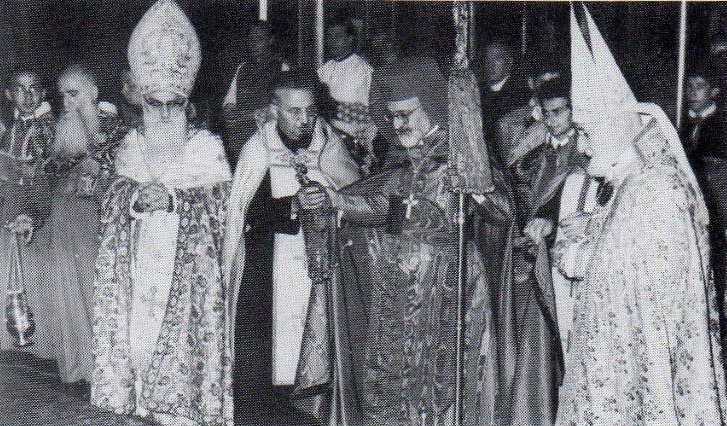
Growing up as an altar boy inside the Holy Cross Armenian Catholic Church in Cambridge, I spent my Sunday mornings assisting its most reverent pastor Father Luke Arakelian.
I would wear the shabig and go through the entire ritual of a Holy Mass, uttering the responses and smoking out the congregation with an incensor.
Each Sunday, for over three decades at Holy Cross Church, the celebrant was Father Luke Arakelian, and he ran a tight ship. His altar boys were trained like Prussian soldiers, answering every call as if the Almighty had ordered it.
One day, he took me aside and said, “Thomas. The Cardinal is coming. You will be his chief servant.”
I thought maybe a glass of water when he needed it or perhaps fulfilling any request made of him. After all, it wasn’t every day such a high authority of the church would be visiting your community.

The protocol I envisioned was nothing compared to what was expected. My altar duties were ready to take a quantum leap. I would serve as his deacon and give all the responses expected of my role.
His arrival to Greater Boston was met with high anticipation. Cardinal Gregory Peter XV Agagianian was here to bolster the Armenian Catholic faithful, stimulate the church populace, and heighten the understanding of our common heritage.
My nerves stood on edge in the days that followed. Suppose I fell apart and forgot the prayers? What if I tripped on my robe and took a dive? Like any sheepish teenager, it was like waiting for a tooth to be pulled.
The year was 1951 and the big day finally arrived. I remember him hearing my surname and smiling, “You are the son of a priest. I couldn’t have a more appropriate assistant.”
Of course, he had two. On the Cardinal’s opposite side was Father Luke himself and down below, a cadre of other altar boys and candle bearers—the whole entourage. It went off like a charm.
My thoughts go back to the 1958 papal conclave in Rome following the death of Pius XII. Cardinal Agagianian was on the verge of being elected to the highest post in the Catholic Church. He received a large number of votes from the College of Cardinals, eventually approaching the majority needed for election. This was confirmed by the elected Pope himself, Pope John XXIII.
In a talk at the Armenian College in Rome, three months after the conclave, the new pope admitted that his name and that of Cardinal Agagianian’s “went up and down like two chickpeas in boiling water” before he finally got elected on the 11th ballot with the two-thirds vote required.
Thousands who gathered outside St. Peter’s Basilica in Rome that Oct. 28 had laid witness to a smokestack ritual. At one interval when the smoke changed from back to white, a new pope had been elected, thought to be that of the Armenian Cardinal. Before the celebration began, the smoke reverted to black.
Had Cardinal Agagianian been elected but declined the post? We’ll never know.
Our paths would cross again two years later at the Mekhitarist Monastery in Vienna, where I was sent to pursue my studies. Every morning for one year, the first call to duty was serving the Abbott General of this vank: His Eminence Archbishop Mesrop Habozian.
And then history repeated itself.
“The Cardinal will be visiting us next week and we would like you on the altar,” the Abbot General proposed. “You may have met him in Cambridge.”
One in the same. An old acquaintance renewed. I was psyched. I remembered the beard, the feisty personality, this passionate disciple of Christ. But most of all, I remembered the twinkle in his eye. If there was any haughtiness in his presence, it didn’t show.
At least a half dozen priests accompanied the Cardinal at Mass that day with me below this time as the altar in Vienna sparkled like never before. He remembered me from 1951 during his visit to Holy Cross Church. “The son of a priest,” he had smiled.
He stuck around the vank for a few days after that. We even got to play a game of chess during a rare moment of leisure. I didn’t stand a chance nor did I want to. He could have been the next Pope in Rome, the first Armenian elected to such a pontifical seat.
Cardinal Agagianian died in Rome in 1971 as the most celebrated Armenian Catholic in history. And I was proud to be his servant.

Dear Mr. Vartabedian:
Your post brought back wonderful memories of my childhood. I never had the honor of meeting or serving Cardinal Aghaganian, I had been lucky to have received my first communion from His Excellency Mesrop Abp. Habozian, the Abbott General of the Vienna Mekhitarists and a fellow Garnetsi like my Mom’s side of the family when he was visiting Istanbul. I have also had the privilege of meeting Most Rev. Sahag Kogian, who was the priest in Boston before Father Luke when he was the Patriarchal Vicar and had visited Istanbul. I knew Father Luke only through the phone when I had contacted him in 1970 while I was at graduate school in Wisconsin, to purchase his Armenian Conversation Course (on 33 1/3 records) for my nieces.
May God bless their souls.
Thank you for reviving those wonderful memories
Wow, such a warm memory to share with you. I was about 6 yrs old, and Father Luke was a dear best friend who played with me– Fr. Lionel Kilergian (sp) (Father Kevon) brought his to this country , and to our house when he first arrived. I remember being introduced to the cardinal, and I even had a private audience with him ( because I didn’t know why I should be in line with all those people and kiss the ring; no one had explained any of this to me. He told Father Luke and my parents to bring me to a small room after. The Cardinal was kind and wonderful. He told me to never do anything I didn’t understand just because someone told me to. And he talked to me. On tha very busy day he took the time. And all these years later, that still impacts my life.
My dad came here from Istanbul in 1959 and lived in the Watertown rectory. I have so many fond memories of Fr. Luke and Fr. George. My parents were married by Fr. Luke. He was a legend..
When I was at St. Basil’s Seminary In Methuen, MA, in 1964, Fr. Luke came during Unity Octave week in Jan to celebrate Armenian Liturgy, which none of us had ever attended. Of course, it was all in Armenian and with no English translation! Afterwards, I asked him why it wasn’t in English. Really BIG mistake! “English? ENGLISH?!!! God gave
us Armenian! If they want English, they can go to the American church!!!”
Years later, I was in Rome for the beatification of Mother (now Saint) Rafqa ar-Rayess,a Maronite Lebanese nun. Prior to the beatification, there was a concert of Church music by a choir of Maronite monks. One of the pieces was an Armenian hymn to theMother of God. It was the first time I had heard Armenian Church music properly. I have heard it a few times since, once in FL when Abp. Manoogian was visiting.
I have felt for years that it is the most beautiful Church music in the world!!!
Are there any photos of the late beloved Fr. Luke Arakelian about whom so many people have fond memories?