



Mayissian: Armenia’s ‘Silent’ National Security Threat
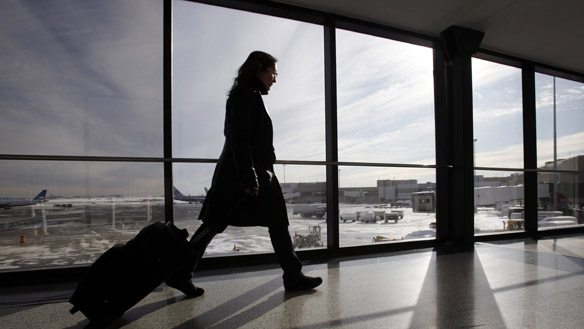
As we make our plans and commit to new resolutions for 2013, at least for some of our compatriots in Armenia new plans will unfortunately mean immigrating to new countries. More than 20 years after independence, outward migration remains the “answer” to the poverty and socio-economic issues affecting many in Armenia today.

As many as 97,000 people left Armenia in the first 9 months of 2012, the Armenian media reported in October. In reality, 97,000 is just the tip of the iceberg. Almost a million people are believed to have left the country during the last two decades, bringing the current population down to an estimated 2.87 million – 3.1 million. Today, emigration is one of the “silent” threats to Armenia’s national security—one with potentially very serious ramifications for the country both internally and externally.
Internally, the ongoing wave of emigration is continuing to deprive Armenia of citizens who may otherwise play a critical role in state-building and socio-economic advancement. As a developing country, Armenia faces many challenges—from establishing democratic state institutions that are able to deliver for its citizens, to driving economic growth and upping the standards of healthcare, education, and other areas of human development. These much-needed reforms can only be brought by people—be they intellectuals, professionals, businessmen, laborers, or artists—people who are choosing to leave the country instead.
Emigration also compounds the country’s already challenging demographic situation. Standing at 1.7 children per woman, Armenia’s low fertility rates are well below the minimal 2.1 births required for the population’s reproduction. Armenia is also an aging society, with those 60 or over (14.6 percent of the current population) exceeding the 12 percent indicator for an aged population. When viewed within this overall context, the serious threats of large-scale emigration on the country’s future population become even more emphasized.
Emigration has societal consequences as well. It is not surprising that in August 2011, the BBC ran a story on Armenia’s “villages of women left behind.” The women of Dzoragyugh interviewed for the article were more concerned about losing their husbands to other women and new families in far-away Russia than working the fields.
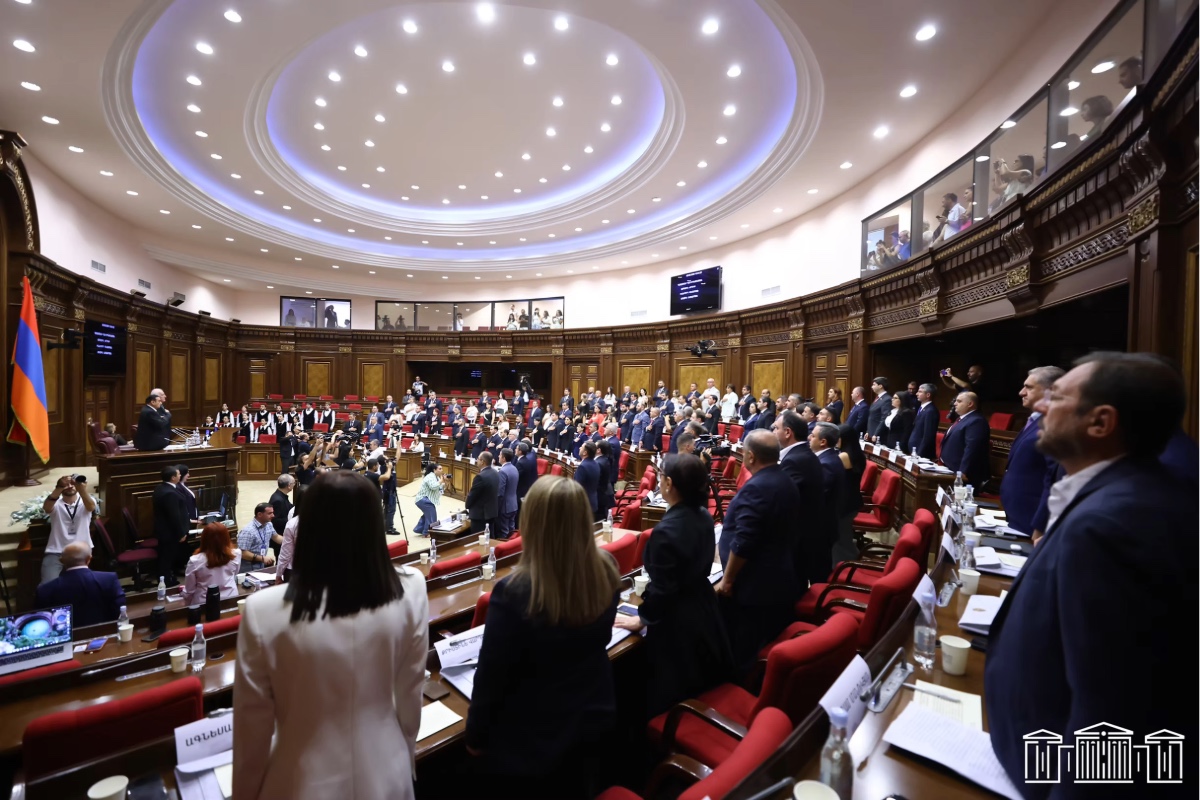

Armenia’s “emptying” villages have also been noticed by our watchful neighbors across the border. “Our economy is growing, while theirs is actually paralyzed. Our population is increasing, while they are facing a demographic catastrophe, there is zero natural growth and mass emigration,” Azerbaijani President Ilham Aliyev said in a speech in October 2012, according to the Lragir news agency. He also called on the people of Azerbaijan to wait until Armenia is “totally empty” to take over not only Nagorno-Karabagh, but also the country as a whole.
Aliyev is famous for his bellicose statements. We can argue that they are for internal consumption. We can dismiss them as the desperate shenanigans of a party defeated in war. We can even feel bolstered by the strength of the Armenian Army and assurances that Armenia can win another war against Azerbaijan if it had to—at least for now.
However, we know that a peaceful resolution of the Karabagh conflict is not on the horizon. We also know that meanwhile Azerbaijan is pumping oil money into its army. According to the International Crisis Group, Azerbaijan’s military spending has increased 20-fold during Aliyev’s presidency to a mighty $4.4 billion in 2012, a figure that exceeds the entire state budget of Armenia. It may not be the case now, but continued large-scale emigration from Armenia may lead to challenges in maintaining a strong army in the future.
Despite the seriousness of the problem, the Armenian government has so far lacked the political will to adequately address the issue of emigration. Government action has been rare and tended to focus on half measures to forcefully curb emigration, rather than policies that provide a long-term solution.
Such was the case when Prime Minister Tigran Sargsyan took aim at Russia’s “Compatriots” program, which assists voluntary immigration to Russia’s sparsely populated areas. “The organization of such activities in the Republic of Armenia is unacceptable,” Sargsyan said in October 2012, in a failed attempt to stop the program from running in Armenia. It didn’t take long for the Russian ambassador in Yerevan to remind Sargysan that “no one makes Armenians go to Russia” and that “people leave Armenia because they have certain objective reasons.”
Regardless of the impact such programs might have, the most effective way to fight against emigration is to abolish the reasons people want to leave in the first place. For Armenia, first and foremost, this means creating jobs, developing a more favorable business environment, and encouraging small and medium businesses. It also means curbing corruption, working towards an egalitarian society, and safeguarding the basic rights of citizens.
Armenia’s ruling parties must recognize that their policies are directly responsible for emigration and must immediately start stemming its tide. With the presidential elections fast approaching, the incoming government must turn its attention to the “silent” threat of emigration and devise policies that address poverty, unemployment, inequality, and corruption. Steps must also be taken to encourage and facilitate the return of former emigrants and diasporans to their homeland.
Unfortunately, President Serge Sarkisian’s presidential nomination acceptance speech in December provides no reason to hope for meaningful change on this front, in the case of his re-election. Sarkisian made no references to emigration except for vague promises of shaping a country that will be “competitive enough to ensure sufficient prosperity to its own citizens, render void any desire to earn a living abroad, and able to summon its children back in a dignified manner—to return to a thriving Armenia.”
In the absence of effective government policies to reverse the flow of emigration, we in the diaspora also have a role to play. We must constantly raise the issue and remind those in power in Armenia—through our media, during community visits and interactions with Armenian officials—of the seriousness of the situation. We must demand explanation. We must challenge the government to take action. As a nation we can no longer afford to stay indifferent to this “silent” threat to the security and prosperity of our homeland.


A much larger reward program is needed for Armenian women to produce children, perhaps even by artificial insemination.
The diaspora should set up and administer such a fund.
I completly agree with Houry Mayissian, she hit the nail on the head.Unfortunately the corrupton is not only within the country, they don’t even care what is happening to the population because they are getting paid by teh foreign governments.
I wonder how do thes epeople go to be every night. Do they ever question their concious?
we have so many intelligent, bright young men and women. why wouldn’t we get large North American, European companies outsource certain specialties in Armenia.
God be with us all.
I think this article repeats Sultan Aliyev’s propaganda without real analysis.
In addition, the author conveniently avoids mentioning NATO supported blockade as the main reason for Armenia’s economic troubles (BTW Armenia had a +4.6% GDP growth in 2011, Azerbaijan – +0.1% – compare such “trouble” to US “growth” in borrowing from China;)
Economic blockade imposed on Armenia by NATO Turkeys and NATO minion Gurjistan is an act of war.
This is all “empirical” population data like “Almost a million people are believed to have left the country during the last two decades, bringing the current population down to an estimated 2.87 million – 3.1 million.”
How about some hard scientific indicators to back up these “believed” numbers? Annual numbers of high school graduates by year? Tons of flour consumed (produced and imported) in Armenia?
And, talking about brain drain, no mentioning of the US Embassy administered Green Card “lottery” – how many young bright highly trained Armenian professionals “won” these cards, sold everything, to come to Glendale and work where?
Great article.
It is the Silent Killer of the Armenian Nation as the White Genocide is the Silent Killer of the Armenian Diaspora. We must demand from the leadership at the highest level, both in the homeland and the Diaspora, to address the issue as a top priority, including the issue of how to stimulate population growth.
When I visited Armenia last year almost every young person I met wanted to leave the country. There is a sense that nothing will ever improve. The key to keeping Armenians in Armenia is economic. The governments prime responsibility seams to protect the monopolies of its friends. You can’t do ANYTHING without paying people off.
After 20 years of independence the country cannot even feed itself! The reason for this is that it is easier to import than to make and importing products are monopolies of the friends of the government.
You stimulate population growth by creating JOBS,Armenia is in the hand of a
bunch of mafia people who only cares about their own pockets.When those people will be kicked out of office or even assasinated out of the government
and their will be a free economy and no monopolies thats when JOBS will be created.We must clean out the crap we have to create jobs even if it means a civil war.
WHERE ARE THE ARF ERS OF MY FOREFATHERS .
The diaspora must stop all TELETONS to Armenia until a descent government is formed in Armenia and get rid of all the corrupted officials from the government any way we can ,even if it takes violence.We are all fed up with the crap thats going on in Armenia.Armenia is under dictatorship ,lets get rid of them. Gorsevetsek mer yergren hanrapetaganner.
You seriously think that The Diaspora’s embarrassing $2.1 million (-10% to Syria) would have any effect on a $20 billion economy?
BTW, the money went to Artsakh to build community centers in border regions, not to the Republic of Armenia.
itotally agree, i think aggressive tactics will probably help, along with setting up extra governing institutes as watchdogs, maybe that may starve the corrupted people keeping armenia backward and diasporan armenians hesistant to return!
The cure for emigration is for Armenians the world over to build our homeland now that we have the chance. We build where we live. Building a country is a nation’s work, not just 1 in 3 who live there. Instead of analyzing what others should do, we should do what needs to be done and not expect it to be easy: nothing worth doing ever is. There will never be ideal (fair, easy, choose your adjective) conditions (and creating such conditions takes work), but at least in recent memory (the past several centuries), conditions have never been better. You don’t have to be in charge to make a difference. There’s a lot of work to be done, but people are distracted from the historic opportunity we have as a nation by challenges, some real, mostly imagined, perhaps a consequence of the 20th-century entitlement mindset, as if the world owes us (individually and collectively) fair, safe, perfect conditions. It doesn’t. That’s part of our responsibility as human beings. It’s time to “be the change you wish to see in the world,” rather than just talking about it or waiting for others (including our own) to solve the problems so that we can make our contribution. Solving problems, overcoming obstacles, surviving failures, creating better conditions, dealing with unfairness and even ingratitude (yes, these are part of the human condition), is part of making one’s contribution. Armenia is a good place to live, work and create, if we are ready to work hard. Enough hand wringing. It’s time to get on with living and working in our homeland.
Like in European countries a child benefit should be paid to the parents monthly by
the Armenian Government. Decades ago France was successfully working with this. Within a few years the resident population was increasing remarkably.
I think the payment of 50 000 dr. per child and month would be sufficient.
But one shouldn´t forget that for our Oligarchs the leaving Armenians are a good
business ! From their new country the emigrants send money to their relatives at
home. And what do you imagine, where are these amounts flowing to ???
“ARMENIA WITHOUT ARMENIANS”
If this trend continues, in 2050 and after the Big powers dream’s probably will be realised!
She is not proposing to repatriate and demand, no, why should she? She is proposing to demand from the comfort of her diasporan life. Please note, I am not saying problems should be swept under the carpet. But I definitely find this venomous style both inappropriate and ineffective.
Now that is one reason for the Glendalean armenians to re-populate armenia, leaving their SUVs and Latemocchas behind.
By the way, the defense budget of Azerbaijan is larger than armenia’s entire budget? WOW! This tells you something!
You are regergetating Aliev’s braggings about Azeri millitary spendings. That shows how Aliev brainwashed almost all his citizens.
Also, Glendalians have SUV’s because we are successful. And also, we help our brothers and sisters and relatives in the country all the time. The funds are flowing, keeping our nation alive.
In addition, many Armenian enterpernuers go back and forth to Armenia who are not considered as permenant residents. Many have properties there.
I hope this frees you partially from your brainwashed state of mind.
Ahmad Khan,
3 millions left your oil Sheikhdom in the last 5 years and they never had SUV!!
Now they own SUVs in Moscow, Dagestan. Chechnya, and joining to Axerbaijani opposition croup, how to overthrow your Agha Aliyev corrupted regime!! You just be happy with your toy guns!!
Thank you for this article. It was very informative and sad.
It seems all the efforts from Yerevan’s politicians are more youtube videos of flash dancers and spectacular firework shows.
I can tell you the problem is not that there is a shortage of beautiful Armenian women and handsome Armenian men.The problem is that if you live in diaspor and suggest that it is best to marry each other and have Armenian children, not only you will be accused of being racist, as well as they will accuse you of being a desperate women throwing yourself at men and wanting to get married, which means you are a freak who can not find men ordinarily.
In fact I can find lots of foreign men to marry me, but I rather marry an Armenian man, the problem is finding that Armenian man.
We have to change the attitude of our Armenians about marrying each other. All they have to do look at their parents I am sure then they will want to marry an Armenia.
Then we should create some kinds of social online networking (only for Armenians), so our young and adult generation will get in touch frequently, without looking at their parents, as their “only” roll model!!
I think there is very little Armenia can do to change the tide without open borders with Turkey and Azerbaijan. And don’t forget that the border with Iran, which is its major trading partner, will be shut when (not if) the Iran war starts. It will be a totally isolated country. Its border with Georgia is open, and thus Russia indirectly, but Georgia is no major stimulus for an economy, and the connection with Russia is complicated by the Russia-Georgia animosity.
I am skeptical about what the Armenian government can do to change the tide, not because you guys are not smart or hard-working enough. It is rather the opposite. Instead, the reason why you are poor is exactly why we Azeris are rich: natural resources. You don’t have much. And you need a catalyst like that in a small country like our countries (unless you are part of a prosperous region like Western EUR). Once you have such a basis, the rest of the economy picks up too (i.e., there are tons of catering and engineers firms, many foreign, who support the oil industry in Azerbaijan, which then generates money for sending students abroad to good schools, people have more money to support arts & sciences, etc).
I am not saying you need to give up Karabachos for prosperity. At the same time though, you need to include your economic dire situation as part of the cost of a lack of peace with Azerbaijan. If there was peace, like Georgia, you too could partake in the regional projects stemming from the Caspian, and the border with Turkey would be open (and thus indirectly with EU). Another cost of the conflict to you is increased dependence on Russia, which, in exchange for her support, is taking over your economy at very cheap prices. And here is yet another cost of the conflict … The arms race with Azerbaijan is causing you to spend a lot of precious resources on military, instead of social support and economic development. We can afford the race, but you cannot, which is why we pursue the race in the first place (even if we cannot start a war, at least we will have caused your economy to collaspse like it is doing now).
So the next time you oppose peace and reconciliation with Turkey/Azerbaijan UNLESS you get everything you want from them, keep this article in mind. You are making your brothers there to carry the cost. And it seems that, like you, they too want out. So if you really want to help Armenia, perhaps you can move there. Yes, you have liberated a lot of “historical” Armenian land. But what use is land to you when you are not there to live on it?
Kerim,
Regarding Turkey, its border closure reflects a continuation of the same genocidal policy begun 1.5 centuries ago. The goal remains the same: empty the Armenian homeland of its indigenous population. In Western Armenia this was accomplished through physical annihilation. In Eastern Armenia now, it is being done gradually through a suffocating blockade. Karabakh is just a pretext. And in any case, you don’t sound too concerned.
Kerim,
The problem is not just resources (ie burried money), but mentality, Armenia would have an even larger corruption issue if she had oil. There is a dark side to oil and Azerbaijan is stricken with that as well as the riches that comes with it.
Kerim,if you want peace then convince your dictator sultan to take the fist initiative by returning the Artsakh territories of Shahumian,Gedashen & lowlands Artsakh.
Secondly what Azeri lands are you talking about?These are all historical Armenian lands.Make yourself a favour & look at the map of Armenia of 1919-1920 & understand what happened during the period of 1920-1940.
Your wish is that the Iranian border is closed.My wish is AXEbeijan will be part of Iran.
Another dooms day article from the AW/Asbarez. Armenia is stronger now than at any point in the past 1000 years! Instead of writing agit-prop pieces perhaps ARFers can put their money and time where their mouths are do something tangible and constructive to develop Armenia.
Armenia’s territory is less than even 50% of either of the neighbouring ex-Soviet republics.
This may be unfair but when was the world ever a fair place.
It could be that the present land area can sustain just so much population.
You want to do something? Join a Fuller Center for Armenia home build mission. 600 families helped to date – not one has left the country. In fact, total family income of Fuller homeowners has increased 30 to 40% after having a decent, affordable home to live in. Check it out… http://fullercenter.org/armenia
By the end of the trip, you will be an optimistic recruiter like me.
Ahmet,
I have to agree with you.The armenians have couple of bad traits that will eventually completely erase them from the surface of the earth, as a -mind you-NATION STATE..mark the differnece ..Armenians!!!
We will endure as Hadvadzagan Damn it people PUEBLO!!!!
Lot of difference, but not as said.
I love the above -don´t care who put it… start YET ANOTHER FUND ling…
Jesus,.untill when do we want to Fragment further more Fundlings more seperate entities. and our Traditional so called leaders watching on…
and if a NUT, like self comes along ¨suggestin¨¨ mind you m not offering or setting FEWD ¨¨A New Statute for the Armenian Diaspora¨¨ they will, no siree never publish it in their MONOPOLITIC PRESS.
Although even one of their top most leaders in the apst wrote ,¨´Any armenian has the rioght to express his her idea__but without adding that it will firstly be aloowe d to see ligh t of day(and they dominate the press) and furthermore implement it , realize it if found Feasible…
” Traits Mr. Ahmet….yes we do posess those tow ultiamtely IMPORTAN TRAITS..and one feeds food to the other…
Best hasgcoghin
“Working towards and egalitarian society”? “Solving inequality”? If you really wanted an egalitarian and equal society in terms of the economy, why did you declare independence from the Soviet Union? We had all those things under Communists.
And widespread corruption is an aftereffect when you go through an immense revolution like Armenia (from communism to republic). You guys should really stop complaining. Thats all you do all day long. Most Armenians come to America for the social programs anyway. Im glad you understand that. Thats another sad remnant from communism.
I also think the reason ARFers complain so much is that they are jealous of the fact that they have not been able to gain power in Armenia for almost a century. Just because Republicans control the country doesnt mean that there is vote rigging. Even our dear America has vote rigging. Maybe people there realize there is more oppurtunity under capitalism than socialism.
You want to keep complaining? Complain about the continuing Westernization of Armenia. Complain about the strip clubs, casinos, banks, and other things that have laid waste to the beauty of Yerevan.
Plain and simple, people leave Armenia for the same reason that most diasporan Armenians don’t move there. Armenians in Armenia feel they may have a better life in the US, Russia, Canada, France, Germany or the UK. You don’t see Armenians leaving Armenia to move to Vietnam because they feel Armenia is better than Vietnam is. Likewise, diasporan Armenians living in the countries listed above don’t leave to go anywhere else because they think their lives would be less safe politically or financially. In other words, Armenia is in the same situation as 90% of the rest of the world.
Above all, I agree with what Tom said. This is the start of the golden age of Armenia if we, as a people that believe we are worthy of a prosperous motherland, grab the bull by the horns and live-work-invest in Armenia. And it is really the only way that it can be accomplished.
Further, for those who believe that we can bring socio-economic change in Armenia while living in the diaspora, I suggest you think about this issue in clearer terms. Positive socio-economic changes occur in a society when they have an enlightened, aware, active population. Those who are capable of these things are neither the upper class (working to keep the status quo) nor the poor (who don’t have time or money for activism). Such change occurs when you have a middle class. Unfortunately, for our nation, our middle class lives in the diaspora, and they are not willing to move to Armenia to do that which is hard, but required.
https://www.cia.gov/library/publications/the-world-factbook/rankorder/2112rank.html
This website gives some statistics about the immigration/emigration of various countries for 2012. See 181. Please see the numbers and due the math.
To Kerim,
Don’t get too exited.
Armenians are getting better at surviving the blockade every year that passes.
And for your information, most of Europe didn’t have natural resources and they have become the richest corner of the world in 20th century. And Japan was hardly with natural resources and they are still economic power to be respected.
Maybe Turkish border would change things a little, but we don’t need the border with Azerbaijan for success. We can do business with central asia through Iran and even Georgia.
Pedros,
You have a point. Armenia is also less than 50% of what it used to be, even if NKR is added to the map. But, I don’t think the border blockade with Turkey has anything to do with it. In this world of increasing globalization I think Armenia will do just fine, as long as the diaspora is there for our brothers and sisters back home.
Leo,
good idea. New ideas are always welcomed.
Houry, while emigration is serious problem it’s not as bad as some media or opposition are trying to present. It’s probably true that 97,000 people left in the first 9 months of 2012. However, you need to realize that majority of those are seasonal migration workers who return back in the last 2 months of the year. I was on the plane to Armenia from Moscow in the middle of November and plane was full of those people. On the way back the plane was less than 1/3 full. As far as birth rates, I feel that number is probably higher in reality because they use in their calculations registered population. If they took into account that part of the population resides temporarily or permanent abroad without changing their residency status then the births over population ratio would be higher.
The best way for now is for both Armenia and diaspora to become one. We must for a unite more than we laready are. Today we can easily keep in touch and listen to Armenia’s real needs. Go back and forth as tourists and see it for ourselves the country and exprearance what is needed more frequently.
This one unit will be composed of more than 10 million Armenians who can bring hope to Armenia.
And if we let things loos what will happen?
Turkey and Azerbaijan will get their historic wish. Armenia will be owned by them one way or the other and they will fuse into a larger unit. We have came a long way in history, predating many cultures and survived them. Most likely we will persevere through this one as well.
Alex, I don’t think Turkey wants to keep the border closed. They almost opened it in 2009. We Azeris had to rush to stop it, by threatening Turkey with taking away our gas supplies.
As strong as the emigration might be, I don’t think Armenia would ever be emptied, no matter what. The worst case scenario is it will be just so sparsely populated to have a decent economy. So it is unlikely that Turkey could ever hope for emptying Armenia (even if they wished for it). Instead, they are keeping their border shut as a pressure point for Armenians (Genocide recognition) … AND Azeris. Azeris, because they say to us: “Look, we will open the border unless you discount your Azeri gas sales to us.” In international politics, there are no friends, but only common interests. Just look at Iran. They have nearly 16m Azeris, and are Shia Muslims, and yet they are more friendly towards you than us (and vice versa).
As a note to other on “Let’s fight corruption” … Don’t even try. It is just too deeply engrained in the Soviet mentality. Maybe in 100 years, it might wear off, after a couple of new generations. It is even worse in Azerbaijan, and we are rich. Even that does not stop corruption.
And Ed, you are wrong about Europe and lack of natural resources. The industrial revolution would not have been possible there without coal and steel. Once those things got the economy started, the rest of the economy took hold. You need to have something to start with. Japan may seem like an exception, but their case is different, because being an island, they had been spared the disruptive wars, etc … so for them the seeding factor was the stability itself, after which they could then venture out and de-stabilize their victims elsewhere (plunder and loot).
Let us not be overwhelmed or paralyzed by the complexity of this problem. I agree with Tom. We have an opportunity in front of us. Most of us in the diaspora grew up dreaming of the day that Armenia would be free and the true capabilities of the Armenian nation would be realized. That day has arrived and we feel depressed or even intimidated by the challenges. In the last twenty years , an incredible number of economic, charitable, development and educational opportunities have created that enable diaspora Armenians to contribute to the nation building. Thousands have taken advantage of this and the benefit has been for Armenia and those who contributed. There is much to do and real problems, but each of us needs to find our niche and focus on making a difference. These macro discussions tend to generate interesting debates but actually sap energy. Focus on bringing your gifts to Armenia.
We have real issues… The border closings are hostile and vial acts, but they will not break Armenia. The corruption is disgusting and tends to extinguish hope for some, but we must never give up on our dream. Who among us is willing to cancel our dream because of obstacles. We must all take action… Not rhetoric, not endless debates but contribute to,the building of hope and the economy.
When Israel was created in 1948, the diaspora played and continued to play a major role in the nation building. Before you dismiss it as not relevant for any number of reasons, focus on the diaspora aspect. Problems? Many, but a commitment to,nation building. As a diaspora, we are at a crossroad. How do we stay motivated while looking at the big picture?. Hold the mirror up. What are each of us doing to make it better. Some can move rocks, others mountains . All are needed. We have no right to be discouraged… Upset…yes….disappointed ….yes but not discouraged. In 1918, our forebear era created a nation out of the ashes of the genocide, surrounded by hostile, warring nations with disease and famine rampant. It lasted only 2 1/2 years but is the territorial basis for our RoA. Sometimes we sacrifice for the future. Not all results are current. Investments with future returns. The spirit of sacrifice for the future will save our Armenia.
Long term solution? We should get rid of the criminal oligarchs in Armenia. Their thirst for money has no limit. A fish starts stinking from the head!
Is it a surprise to anyone that Kerims and Ahmets are like flies attracted to the “honey” of this article? While the country is at war, including a psychological warfare, we have self-styled “experts” in national security spreading exaggerated banalities as “national security analysis” and platitudes of “demands” as policy recommendations. Want to demand something? Fair and square – repatriate, send your son to serve on the border facing Mameds and Ahmeds and your demands will be understandable if not acceptable. Otherwise, spare us from this patronizing gloom and doom.
well said Arthur.
Stepan,
I wish that many Armenians in Armenia had the great spirit and optimism that you have.
Another pessimistic article written by Diasporan Armenian, and as usual, Armenians who emigrated from Armenia for better life criticizing the rest who stayed there. If people stop telling ferry-tales to Armenians in Armenia as to how the life is beautiful abroad perhaps fewer people will emigrate.
I was talking to my cousin who works as a librarian (her husband work as a school principle) who told me that they were planning to emigrate to France illegally. I asked why? She said my sister-in-law just emigrated with her family to France they said it was great there. What is exactly great, I asked? Well, they slept a few nights on street, but now the government gave them some space to live in a resort city, food and clothes, and they did not have to work, she answered. I do not know why she thinks that it is O.K. not to work and receive money from the government, let alone from a foreign government, but that is exactly what she thinks. Needles to say I was not able to convince her. Does this story sound familiar?
The thing I hate the most is when Armenians start pointing to other countries that they consider a model of what Armenia should be. Comparing Armenia to Israel is an invalid comparison because Israel was not under communist rule for seventy years. It also fought three wars which strenghtened it self esteem and its diaspora did not continuously complain about how terrible the country was.
I am getting to the point where i am beginning to believe that Armenians in America want to dictate Yerevans policy. How come no Armenian in America ever speaks of increased Russian- Armenian trade or increased Iranian-Armenian trade? That surprises me becauses those countries are right next to us, unlike America which is 10,000 km away. Why do we expect this country to solve Armenias problem?
Stepan and Tom, thank you for your optimism. I think if knowledge power then now we know and we have the opportunity to do something. Armenia is not emptied and has every part of machinary that a normal government posesses. accept that the parts need to be fine tuned without assuming we need to open borders all of a sudden.
The answer is diaspora as I mentioned. We should thank internet and cell phones for giving us power to keep in touch with mother land, and giving us the access to news about Armenia, and more.
We, Armenians have done alot for our country, but if more is needed we must pull up our sleeves and do so.
Action speaks louder than words.
Sella and Ed.. Thank you for your kind words. Armenia and Armenians have survived the calamities of our history because of our faith, our ability to adapt and our incredible ability to believe in the future. That has not changed. For many of us, we are internalizing the shock of the post-Soviet culture in our Armenia. Although, we may intellectually understand the impact of the Soviet period on the social and political environment , it is another reality to witness the impact it has. Compared to what our ancestors have experienced, the current challenges are manageable.
Gevorg, my comment on Israel was limited to the role of the diaspora. You are correct. Complaining about Armenia in the absence of commitment and action is , in my view, not helpful. Our job is to provide material support that gives our brothers and sisters hope, dignity and a quality of life. Thousands are doing that and I thank God for their commitment. We pray for a free Armenia for seventy years and when it happens , we grow impatient with the evolution. The RoA must be viewed as the next chapter in our 3,000 plus year journey. We have a role to lay just as our ancestors did.
We glorify Avarayr and Vartanantz, but there were many corrupt princes and even traitors. We romanticize our resistance to Turkish oppression, but what of the corrupt Armenians who betrayed their brethren and helped identify our leaders. Human weakness exists in our midst, but good will always prevail. Use the passion we all have for our Armenian identity to make it better. As Armenians, we are inspired by our ancestors and motivated to provide this connection for our children. This same loving and honorable approach that has fueled our communities in the diaspora must be the same approach to Armenia. Everything we believe in depends on it.
I should be the last one to stand up for Armenian Weekly. But I think the criticism of this article because it is “gloomy” is misplaced. So what that some Azeri schmuck like myself comes and reads it and “rejoices” in it? Would you, because of that, prefer not to hear about some of the gravest threats to Armenian nationals security? How can you solve a problem if you don’t even want to hear about its existence? And the problem is very real. From the perspective of your “enemies”, this problem is actually the weakest point of Armenia, which is implicitly being used to pressure it in negotiations (e.g., “Hurry up and compromise now, because tomorrow you will be an even weaker position.”)
Tom and Stepan, I appreciate very much your words of encouragement and reminder to all that we Armenians have the power to create change. There are those who intentionally spread discontent and hopelessness to weaken our resolve. Your message is the message that should be coming from the leaders of our nation both in Armenia and Artsakh and the diaspora. The people should demand more from their leaders. May your attitudes inspire many to see the hope and possibility that awaits us in our free and independent Armenia.
Emigration is a temporary problem.
Corruption is a temporary problem.
Hunger is a temporary problem.
Domestic abuse is a temporary problem.
Unfair elections are a temporary problem.
Poor housing is a temporary problem.
Unemployment is a temporary problem.
Lack of power is a temporary problem.
Low birthrate is a temporary problem.
You name it. All our problems are temporary problems, unless we give up and let the gravestone to the Armenian nation be carved by our pessimism.
We are building a nation. Let’s solve the problems that come with it.
True,
These are all problems that are like acne on the face. They come and go in varying intensities and never kill us.
I think the problems Armenia has are shared by many nations which got their independance from Soviet Union and eastern Europe to varying degree.
We must be vigilant and optimistic, at the same time causios and calculated. And last but not least, proactive and pesistant.
There are many industries and opportunities that are open for Armenia’s growth. We don’t need to have oil dependant economy like the middle east to survive. It is better to depend on human resources of our nation to thrive in global economy and socially, pluss have strong millitary to defend ourselves.
With all the negatives,always remind yourselves that this & previous Armenian governments were able to keep Artsakh free & very strong & that matters most.Please read the here below:
20:33, January 1, 2013
Ilham Aliyev, the President of Azerbaijan, has won the first ever Organized Crime and Corruption Person of the Year bestowed by the Organized Crime and Corruption Reporting Project (OCCRP). The award is given for the person who figured prominently in 2012 on stories on crime and corruption in its coverage area. Aliyev was chosen because of new revelations this year about how his family had taken large shares in lucrative industries including the telecom, minerals and construction industries often through government related deals.
The award is chosen by the 60 reporters and 15 news organizations that make up the OCCRP consortium. Runners-up included Albanian drug lord Naser Kelmendi, President of Uzbekistan Islam Karimov and Russian President Vladimir Putin.
http://hetq.am/eng/news/22001/occrp-names-aliyev-person-of-the-year-.html
Boyajian
I agree with your statement however some of them may be more important than the others. One thing I want to say here is most Armenians see the diaspora as a state or some sort of great power and bragging about their diaspora. To be honest, I find this idea idiotic and ridiculuos. I bought a few properties in Turkey as I have decided to return to my homeland Why? What is the ultimate fate of an any diaspora community?
you find this idea idiotic and ridiculous because you are a Denialist Turk.
you guys live in an alternative Universe.
I am glad though that you are returning to your homeland: it is beautiful and peaceful there. very pastoral. here is a picture:
[Dukha, ‘lost Turks’ in Mongolia]
http://www.hurriyetdailynews.com/dukha-lost-turks-in-mongolia.aspx?pageID=238&nID=33993&NewsCatID=381
hopefully there is internet access there, so you can keep visiting us @AW.
TODOS TENEMOS RAZON!!!Spanish.means,rather to the effect that we all have some reason -in what we say,write-I mean in this case ABOVE.
Firstly Kerim *I very much dpoubt if he is a turk or kurd,rather he is an armenian trying to stir up debate, talk amongst us…Mark my word…
Now then Indeed Gevorg is also somewhat right ,so is Jacque and eta al…Me?
I never (have decided long ago,when i became an activist extra officially in Europe ) to offer, present or set forth….to fellow Armenians..
I tell you at my age son very soon 82..I have learnt that armenians tend to be Jealous of ea other´s no , not only wealth but also ea other´s good ideas!!!!
Whereas , the intelligent people or those who have learn tob e so at a cost, like the people of Spain(yes the country of Javier Solana,man for 10 yrs at the helm of the EU(not the Brit gal , Ashton) .They used to kill ea other during 1936-39 the Civiñl wasr the Left ultra left and the Facchas(ultra Nationalist.
But i was invited to the liberal club(not politial party there when i haad put just couple of articles in spanoish pres re our CASE.When -exactly-a so called kurdish group (I suspected very much Trukish )had placed Yerevan on the future map of Kurdistan..I gave them hell ,sayin,Armenia now is part of all might soviet union and it would be-creanme ,believe-very tough to claim anything form thaT ENTITY AND A LOT ,MORE…ANYHPW.
aT THE cLUB , IN THE END OF THE 70´S WHEN fRANCO HAD CEASED TO BE ..they sat together in the plush hotles that ht eliberal club would rent ,cCOMMUNIST AND fACCHA sOCIAL DEMOC.Socialist and christian democrat etc.,m all TOLERATING EA OTHER….no more agaisnt ea other…
aND THEY ACCEPT BY MAJORITY VOTE GOOD IDEAS SET FORTH OR SUGGESTED COME FROM ANY OF THE AOFREMENTIONED..
Spain had come a long way……wISH ARMENIASN WOULD LEARN THAT TOO!!!!!!!!!!!!
CRAZY OVERJEALOUS ARMENIANS..THEY DO NOT AS YET UNDERSTAND IT IS THE IDEA PER SE THAT COUNTS, NOT THE IDEALISM OF THIS THAT POLITICAL PARTY.IT MAY COME FROM A COMMUNIST , A NATIONALIST ,BUT IF IT IS OF NO USE -TO BE DROPPED-IF GOOD TO ACCEPT IT WITHOUT ANY JEALOUSY OR GRUDGE….
tHIS IS THE M A I N ISSUE THAT HINDERS THE ARMENIANS FROM FORGING AHEAD. Also…
So far none of our entities is really IMPARTIAL….either black or white!!!!!!
God, can´t we be in between abit too.Try to mutually compromise come to a compromise!!!Learn armenian Learn,at least from the neighbours…..
Now then I hav written two very important ¨paper¨s dealing with the diaspora re organization so far none of our weeklies has publishsed them.Neither in English nor Armenian.Beacuse simply put it is not in conformity with their either lexft or right IDEALISM!!!!!!
so I shall email to many many.If anyone here-even Turks or kurds intersted write to me and I shall cc to you all. gayzagpal@aol.com
BTW there wass an Armenian site called -armeniannews.info,which ,went off.There the nice yougn maan had alreaady inserted 5/6 of my articles.But i have them saved can FWD to anyone who wishes to learn more about my suggestions…
Hama haigaggani sIRO,
Gaytzag palandjian
Reply to Azeris
What everyone says matters, even the negative ones. What I mean is that if you even hate Armenians at least what you say is something that let us know of your countries collective psychi and helps us to stand gurad against threats.
I just want to point out to your perspective of what you think is the problem. Most Azeris and quiet a few Turks claim our problem is solely from border blockade by Azerbaijan and Turkey. obviously that plays a part, but unless Azerbaijan and Turkey are not carrying out other activities to further intensify the issue I doubt the blockad can cripple our country and economy.
The assumption by Azeris that Armenians have the worest of the three countries is what bothers me. Our problems are part of the collective caucases problems that the region is facing. Despite Georgians haveing access to black sea and larger territory, they are not that much more higher GDP than Armenia and their problems are very similar and even in some cases more sever.
Also, with Azerbaijan, the only thing that keeps you going is oil and gas, other than that, you are still highly dependant on Turkey as we are on Russia.
Obviously peace in the region will take the load off everyone, but how it is obtained is the question. But, with border shootings at Armenian civilians and cases like Safarov’s pardon the distance between peace and present is set even more appart, besides other issues between the two neighbors.
In conclusion, I think most of what makes a country what it is depends on its citizens and government. Secondly, on diaspora of that country who are spread out globally. For proof, many nations rose in glory in lands that were land locked and had no resources. I believe Armenia has the chance.
Sella, you are correct. Most Armenians are still in the mindset that the governemnt has to provide for the individuals well being. Most Armenians that emigrated to America after 1990s could care less about how this country will benefit them. They came here for the free housing, food, money that the government here provides. I hace heard many Armenians spit on this country yet they proudly state that they fool this government and recieve aid.
Stepan, you remind me of Democrats in America who always complain about how dreadful Americas presidents were before FDR. Who cares if our princes were corrupt? They saved us from annihilation, did they not? Have you ever seen a Turk complain about how corrupt Sultans were cause I havent. I guess complaining is in our genes.
As someone whose family immigrated to the United States in the early 90s, though not from Armenia, let me say this: most people don’t immigrate to the US from countries like Armenia or Turkey (in my case) to fool the US government and life an “easy” welfare life. They come here to escape their homeland. Escape some aspect of it, whether it be economic hardships, war, persecution, or a combination of countless other reasons. Are you one of those “proud” diaspora members that have only visited your homeland 3 times in your life? You can add looking down on people for arbitrary reasons to your own personal list of genetic shortcomings.
Most immigrants from the former USSR came to the US for economic reasons, not political, humanitarian, or religious. Whether they came to use the system or not is another issue. But Gevorg’s overall point is valid.
Gevorg:
you need to read Stepan’s entire post before reaching your conclusion.
he is saying the exact opposite of what you think he is saying.
Fortunately the AW allows comments, some that should not even be posted. A good forum to vent, but sadly with no tangible results. Too much rhetoric and most of the comments lack objective and meaningful ideas that can be truly realized.
Armenia is a very young independent nation. Admittedly it has several problems; economical, political and social that it needs to resolve. Whether we like it or not, the people who live in Armenia have elected a government; how they were elected is an issue that we in the disapora can do nothing about. Change has to come from within. We must give Armenians in Armenia some credit; not everything they do or do not do is wrong and should be subject to a tirade of cirticism.
We, in the diaspora, can only support and help when we can. Instead of continuously complaining, find a cause, a group, an NGO, a non-profit organinzation, and lend your support. JUST DO SOMETHING ; every little helps.
Our problem in the Diaspora is that we do not have a strong unified leadership to influence the government in Armenia. We are too fragmented and do not have a
common vision of what we need and should do. Sadly, it has become a platform of
unending rhetoric rather than meaningful unified action.
Vart Adjemian
Vart adjemian is correct. Could not have said it better myself, whether or not vart agrees or disagrees with me.
In this case big Armenian organization, such as ANCA, AAA, and Justice For Armenia in Europe, or Armenian Union in Russia, should have meetings and lectures, like civilize and positive way, and help Armenia’s position in today’s complex world.
Armenia surrounded with sea of hostile Muslim dictatorial regimes, we should be able to make Armenia’s people to believe and obey, the implementation of the rule of law, democracy, freedom of speech, justice for all, corruption, that should be controlled and guided only by Armenian Parliament and reduce the power of president over Parliament!.
No the Diaspora should have no say in what Yerevan does, except when it comes to dealing with Turks and Azeris. Armenia has people that are smart and know what they are doing. What you are advocating GB is an American style government in which Congress is supreme. Armenia is a parliamentary system and in those systems the power of the party and president triumphs. Also, when you speak of democracy and freedom of speech, do you mean the style we have in America because there have been some nasty developments in the past half century. I mean, I would limit freedom of speech and democracy in Armenia if it meant keeping Armenia a homogeneous culture and society. Maybe Armenians do want the Republican Party in control. Who knows? Maybe fraud is exaggerated by the opposition parties. If Armenians did not like the Republican Party, then neither Serzh nor Robert would have become president. There are 15 candidates running in February elections, lets see what happens. By the way, speaking of fraud, Im sure if you dig deep the 2012 American elections also had fraud. I have read reports that show that counties recorded more turnout than there were voters registered.
What I mean is that we can help build schools, plant trees, and other humanitarian stuff like that but we as Diasporans have no right to meddle in Armenia’s domestic policy.
At long last!!!
Vart Adjemian above has meaningfully described the character of things Armenian,whether here or in general on the Armenian Diasporan Scene. A SodomGomorra…in Armenia there use dto be another denomination for that let me think……………….oh it just came back.Arshagavan. An epoca,sorry i wrote that in spanish and era when the armenian prince*lings-nowadays Oligarkhs in RA, BBB’s in Diaspora * this is what Canadian armenian writer philosopher Ara.Baliozian for your info.meaning Bishos,Bosses and Benefacots *you translate what he means-let me tell you-The Spirituals, the Politico and the Diaspora’s very well to do that can afford charity*in their names of course!!!
Dear vart.In Armenia I help*sorry for saying since many yrs a small handicapped childrens centre…in Avan arinj.Also other small donations to all Diaspora entities that help Amenia’s such. Like the Eyecare this and that the list is long…from habitat Armenia now called fuller etc.,
But I KEEP INSISTING AND THAT FROM MY 24 YRS IN EUROPE TO COME TO A CENTRAL SUPREME COUNCIL OF THE DIASPORA.But I let alone the existing ,lest they consider me as an antagonist or competitor…Let them go on with the GOOD work they are doing but we need much mmore to muster up Clout, have huge BILLIONS OF DOLLARS WORTH n a t i o n a l I n v e s t m e n t t r u s t f u n d
.This does not cros with any.LET THE ARMENIAN MINDSET COPY Adn invent many more fund-LINGS BUT THIS WILL BE THE investment one there to stay.aND GBUESS WHAT IF WE ARE TO SUCCEED IT IS TO BEGIN FROM UP TO DOWN THAT IS OUR 6/7 MAGNATES INVEST INTO A WORKING CAPITAL THE NUCLEUS TO HIT THE BILLION DOLLAAR AND THEN ALL THE WAY DOWN FROM MILLION DOLLARS DO HUNDRED THOUSAND TO HUND DOLLARS A SHARE INTO IT.Latter from the Armenian public and ABove alll I advocate for the FORMATION INTO PCA’s Prof. Colleagues assoc. 5 on the scne , 10 more others needed where over a 100,000 Armenians at present ar working in their professions.The backbone of our nation whether inDiaspora or even in Homeland.Again, I hope AW will publish my 7/8 pages long””PROJECTIONS ON A NEW STATUTE FOR THE ARMENIAN DIASPORA”” AND THE aRMENIAN VERSION QUITE DIFFERENT BUT TO THE SAME END.
bEST TO ALL hAYORTIS WHO WISH TO HAVE dIASPORA STRUCTURE RE STRUCTURED.LEAVING ALONE THE bbb’S AND THE oLIGARKHS LET THME GRIND THEIR OWN …
HAMA hAIGAAGANI Siro,
gAYTZAG pALANDJIAN
Thanks Avery. Gevorg, my brother… I was just trying to say that we collectively are bigger than any of the problems today. The “good old days” weren’t as perfect as our perception of history, but you are correct… We survived. Why is today any different? We must reject negativism as destructive. Our job in the diaspora is not to control Armenia with our “enlightenment” but to support their nation building. We must give of ourselves and our material good fortune without expectations. Some things will work out, some won’t, but overall Armenia will benefit. Providing political flank support, economic development and expertise where appropriate will build hope. With hope Armenia will stabilize.
Sorry, brother, I misread your comments. I agree with those that say that we should assist Armenians in Armenia in building a unified Armenia. There are also some who would like Yerevan to listen only to the Diaspora and to no one else.
Gaytzag, no, I am not an Armenian or a phantom poster created to stir up a debate. Say whatever you may say about Azeris, but I do take a very strong offense at any attempt to question my individual existence. It just is not a nice thing to do to someone.
But just in case you are curious or care, my Azeri great-grandfather did come from Armenia circa 1900s. So I guess you could call me an Armenian in some sense. I certainly have the nose, that is for sure. But still make no mistake and rest assured and relax: I do remain firmly unfriendly towards Armenia, as long as it is occupying the areas adjacent to Karabak proper, and as long as it continues to call grape-dolma a food stolen by Azeris.
I guess I sounded too reasonable to be an Azeri (in your mind). That I will take as a compliment (or do you spell it as ‘complement’ … not sure). Having gotten a lot of abuse here, being called a Bloodsucking Zombie Mongol or something like that, I will take whatever I get, although I do wonder what the heck I am doing here. Adios! I will try to stay away.
There were no Azeris in 1900s. This artificial “nation” was created by Stalin in 1930s. Before that people who call themselves Azeris or Azerbaijanis now were Turkic speaking nomadic tribes. Collectively they were referred to as Caucasian Tartars by outsiders. Internally they called themselves “Muslims.”
Most of the “Muslims” of Nakhijevan region were actually not even Turkic, they were Kurds. For example, the Sultan Aliyev’s family are all Nakhijevan Kurds. General Heydar Rza-ogly Aliyev, made his career in Soviet KGB organizing Kurdish rebels into parties to fight the Turks after they joined NATO. The clan is actually still quite hostile and distrustful towards other “Muslims” and prefers to surround itself with loyal Kurdish bodyguards and troops. They also bring tens of thousands of Kurdish families from Turkey and Iran to settle on occupied Armenian lands.
Since nomadic Turkic tribes were a minority and didn’t have their land (didn’t need it because of their lifestyle), the Soviet nation building machine changed ethnicity of native to the region Tolysh, Lezgi, Tat and other groups to “Azerbaijanis” thus artificially creating a new “nation” and inventing its history in just 2 generations.
This phenomenon is quite visible now when an Azerbaijani person is asked about their ethnicity. Their answer depends on two factors – their ancestral memory and the location of the interview. If it is inside Azerbaijan borders, a descendant of one of the native groups would say that he or she is an Azerbaijani because they are discriminated and forcibly assimilated by Azeri Turks. If it’s outside of the Oil Sultanate, they would tell you the truth that they are Tolysh, Lezgi, Avar, etc.
An opposite scenario is true for Azeri Turks who feel free inside their artificial Azerbaijan Republic so they say the truth that they belong to one of the Turkic tribes of Kara Koyunlu (Black Sheep) or Ak Koyunlu (White Sheep), etc. Outside of their turf in Azerbaijan they feel threatened and prefer to become “Azerbaijanis.”
Voskana … Are you for real? I mean, hate us, fine. But you just are talking nonsense. Who on Earth calls himself a Garagoyunlu today? And Aliyev is a kurd?
And you mention the presence of minorities in Azerbaijan. Yes, we have a lof of them, and are very proud of our tolerance. How many minorities are there in Armenia? All killed and evicted, right? If anything, their existence in Azerbaijan disproves your points. We are not a hateful nation. You are.
Anyuways, no more need to reply to your schizophrenic comments. And fine, continue believing that we are a fake nation. You will soon taste total vanguishment at the feet of a fake nation. You will know then what is real and what is fake. Just be patient. Your Russian patrons can be bought too to stand aside. We bought Hungary, didn’t we. In international politics, everything is a matter of price.
No Gevorg, I am not in US, or advocator of US democracy, I am for the people of Armenia, there are hidden and bumpy obstacles that bothers ordinary Armenian population, and that is because of Armenia’s Justice System does not comply with basic people’s demand.
Simply there is no trust between people!!That has nothing to do with US or European mentality, it is pure Russian mentality, that’s come from Bolshevism, that people in Armenia are suffering, that has to stop!! Oligarchy system is a Russian base system, which is very common in ex communist Eastern European countries, where most ordinary people are suffering even today!! That has to stop in Armenia!! (Hungary and Safarov case is an example)
There are too many self proclaimed corrupted judges in Armenia, where appointed by Oligarchs to run their own businesses and suck more blood out of people’s body!! That should stop as well!!
If Armenia improve moderately, then I will call a step forward toward “democracy”, and that has nothing to do with Russians or US or KGB or CIA or you name it !! To me happiness and unity of Armenians of the world is more important than, dirty political games against our nation in Armenia!!
How did those oligarchs go from nothing one day to everythimg the next? Was there a power void that needed to be filled? How come people in Armenia support the opposition party Prosperous Armenia when it is headed by an oligarch?
To Kerim,
You have a very Turkis Azeri method of going around the issue and half admitting that you do have something INHERITED from great great granpa,even if it is in the form of a NOSE…voila Armenians learn from this chap how to be flexible to be camaleon type and yet STAND THE GROUND.See what I meant when I posted that the turco zeirs never give up ,even if their back hits the floor*like in a wrestling match..
And in another short post kerim points to a weak point of us in Diplomacy and writes we are in a hurry to accept ,come to a compromise with them*this ,in a suggestive format.Indeed the turco azeri mindset at its best.
NO KERIM, NOT ONLY -YOU ALSO HINTED THIS-the surroundign areas will not be ever ceded to Axerbaijan*AFTER SAFAROGLU YOU DESERVE TO BE DUBBED THAT PLENTIFULLY…
BUT WE ALSO HAVE OUR EYES ON SHAHUMIAN AND MARDUNI,PLUS NAKHIJEVAN!!! those are millenia old Armenian lands….
So stop you very sublte maneuvring trying to poison our soft ones…
Hey Vart!!!!! why don’t you write a word or two re my DRVADE-ing you..
A word at least that I have seconded you..Courtesy at least if not anything else.
Rarely does an armenian HERE, let alon in general comment or try to sort of compromise or shape up at the least other’s viewpoint.No siree,except perhaps one or two mainly Gals….
Talking about Oligargs..also pick up what aRA balkiozian says too,please not to be impartial…Our BBB’s in Diaspora!!!!! same cloth in different cut format and ..
Well I have said enough for those who follow the thread. We either become more SOCIALLY FORMED or stay as BBB’s and oli…s
An oligarch inherit their fortune from their past roll models, when his father or uncle was a part of KGB or Communist clan, or was a local gang leader during Soviet times, who was a secret “brave” fearless outlaw gunman. People in Armenia has no other choice, but to follow the stronger ones who has more cheating power, like an oligarch or tuks call them Khan. Just like the owner of Harsnakar clan, whose father was a member of a communist clan during Soviet times, who killed an Armenian army doctor, and now walking freely in Yerevan streets. where people after few rounds of demonstration forgot about Mr. nice guy!! Even the president of Armenia could not ask for his arrest!!
Right now oligarchs have more power than government officials in term of helping the society needs, the local oligarch (Khan) is an individual, who look after his group and his faithful members. They have fearless criminal members, who are willing to die for their mafia boss.(the provider) Government official is a person who look after his pocket and his immediate family like a police officer or a border guard or a corrupted judge, they work indirectly for each others!!
Rest of Armenian societies, are like livestock for both oligarchs and government official, they get milked, until there is none left. finally, when they run out of milk they join to illegal underground work force, which is control by another oligarch!! And may God help the poor ones, nobody cares for them, but if they they are young, then Russia is waiting for them, they need laborer in Moscow suburbs for temporary seasonal construction work, and if they become lucky and find a Russian girl, stay there permanently!!!
Now this is the best part, most educated Armenians, such as artists and engineers, nurses, computer and software specialists, Professional painters, musicians, scientists, Engineers, when they see there is no hope and future in their field, jump to the first available plane, toward Western Europe or US, even as a refugee with minimum pay!!
I met an Armenian man, according to him he is an electronic Engineer like myself, and was looking for any kinds of job, connected to his field!! I asked him what was the reason, that you left your beautiful Armenia?He answered me angrily “It is time to change, why you guys don’t go there as an electronic engineer and I will take over your job and become part of diaspora Armenian?
Now dear Gevorg, you are talking about election or Raffi or serge or any other clan, in Armenia!! There is fundamental problem with our beloved Armenia. Raffi and opposition won’t be able to change the country overnight !!
Armenia needs to be overhauled by his own people and with their own power, of course with help of diaspora Armenians!! People, who born and raised outside of Armenia and they kept their ancestral roots, does not mean they will be able to change the attitude of our beloved Armenians in Armenia, in order to see a strong, beautiful and happy Armenia, militarily, economically and politically!!
Change must come from within Armenian society, and their willingness toward a big “change” which is not an easy task. I am sure you will see huge investments from diaspora Armenians in Armenia!! We don’t need Russia or US or EU to help us in order to survive!!
Gaytzag, just a couple of things …
1) you mention that we Azeri never call it quits, and accept curren realty of having lost. Well, barely a sentence away, you lay claims to Nakhchivan, whih is now part of Azerbaijan. What, we are to accept a loss from only 20 years ago, but you are stil fighting a fight from God know how many years ago, 500 or 5000?
2) Also, what is going to happen to the 500,000 civilians who live in Nackchivan today when you “liberate” it? I know you you guys claim it as your historical land. Ok, let’s even grant for argument’s sake that it was yours, but at least for the last 500 years it appears to be a Turkic/Azeril land (e.g., Savavids, etc). So, let me get this straight … You are going to kill and evict over 500,000 civilians who have been living there for at least hundreds of years BASED on a quisi-religious quisi-historical self-serving interpretion of something that may or may not have happened a thousand year ago. Who, my friend, is the evil one must watch out for, me or you?
Yes, Armenia has had a great history, but let’s be frank … it has not been great for at least 1000+ years. Why are you so still hostage to it? By the way, having been around for a long time does not necessarily equate greatness. Trees have been around for much longer than humans.
There are no 500,000 civilians in Nakhijevan! The elites left for Baku long time ago together with their boss. The poor moved to Turkey.
The remaining nomads will run away as soon as they hear that the true owners of the land are returning. The same thing happened in Artsakh when entire villages occupied by nomads were moving out in one night without anybody attacking or threatening them. They just knew that their temporary occupation of Armenian lands (and houses) was over and it was time to move to another place which is natural to nomads.
Before Stalin gave Nakhijevan to the newly and artificially created Azerbaijan Soviet Socialist Republic, Armenians composed the majority of its population followed by Kurds and then nomadic Turkic speaking tribes. In just 50 or so years Azeri Turks managed to get rid of all Armenians there. Why so slow? Because they couldn’t use their usual way of ax and burn and had to act civilized. But they still live in houses built by Armenians, they only now finishing the destruction of the remaining Armenian churches and cemeteries and they know damn well that their time is over.
Voskana…, thank you very much for reminding me once more who the fascists are? Here you are, opening advocating the destruction of a whole people you call nomads. And yet almost in the same sentence you accuse the other side of barbarity and aggression. I mean how much of a hypocrite you can be. I resent people like you, whether they be Azeri, Armenian, or whatever — the world is a horrible place because of individuals like you. The Turkish perpetrators of the Genocide were just like you … looking for and always finding excuses for murdering and evicting peaceful people.
By the way, why dont you trie to come and get Nakchivean? There is a saying in Azeri “Gudurarsan ay it?” Meaning, you got the Karbaak in the chaos of the post-Soviet disintegration and now you are full of yourself. You silly man … leaning against Russia to bark at the big boys. Russia will not be there for you forever.
I look forward to the day when we will erase the victories that have pumped up your self-confidence disproportionately. What is it that you accomplished? You did not face a real army. Instead, civilians had to feel on the back of trucks after seeing what you were capable of doing in Khodjali to civilians left behind. ANd htat is what your president Sarkissian has admitted to: strategically massacring civilians to scare off the people from their land. And they succeeded … for now. You think we are just gathering advanced weaponry for play … sooner or later you will taste the wrath and you will, once again, be left with nothing to be “proud of”.
1.Nakhichevan was lost in the Soviet era & emptied of Armenian circa 1960-1980.It has been our homeland for thousands of years.We are not dealing with lost lamb or sheep.
2.Civilians can be evacuated peacefully similar when the Azeris of Armenia left with no one being killed unlike the pogroms of Armenians in Sumgait,Baku,Girovabad committed by Azeris.
3.Artsakh war was fought by common Artsakhis & not by an army.You have not faced yet the might of the Artsakh army.These people are defending their thousands of years homeland & have the example of Nakhichevan & Western Armenia.
4.We could never live together with all this hatred & Armenophobia.You stay within your borders & we’ll stay within our borders.
Again,very conveniently Kerim overlooks Shahumian and Marduni Armenian !!!
Nakhijevan ,where I have very legitimate Claim, house of my grandparents and their fields..only about 40 yrs ago was populated by us Armenians.Yes your cunning Aliev Geidar Heidar…worked day and night around Breshneve.I have heard taking to him Jewellary and Caviar-when he was part of the Politbureau!!and got green light to by and by push the remainign then in the 1960’s some 40,000 Armenians out!!!!
Prior to that the count of Armenians there-when hell broke loose-*read prof. Richard G. Hovannissian 4 volume Republic of Armenia,in one of them there is much reference to Nakhijevan,when in 1918’s Kemalist Turkey send in speciallly trained officers to stirr up and agitate the tatart azeris*farm hands servants of Armenians and or just neighbpours to start agitatating ,looting setting fire to armenians houses etc., thus starting the PROCESS of de-population of Nakhijevan.Before that some 160.000 Armenians were there alongside dribbled in azeris tatar herdsmen…but indeed increasing as the armeniasn were removed from there.
Right now in Republic of Armenia there are close to forty thousand Nakhijevantsi and quite some in Diaspora….all getting ready and awaiting when another NZHDEH will come FWD and settle that issue as well as we did in NK.For your and others info now. From an Iranian armenian close friend who has good ties with Persian friends.At present nakhijevan is used by Iranians a a general prostitutional area where lower class iranians go for fun and there is no basic structures there and only as described for FUN.I doubt it that there are 500,000 azeris there. Not even half that much.You guys know who double triple counts when it is in your favour.But when I state 40,000 nakhijevantsi in R.of Armenia , the head of the Union of htese there has statistics in yerevan and stated so at the Academy of sci .where I was attending ,thanks to his invite to me…
Armenia since 1918 gained Independence,but prior to that we were around Armenia ,mainly in Georgia Tiflis*now Tbilisi….close by and indeed Western Armenia…..millions of us in the latter until 1915,when reduced to a tenth of previous 2.5 millions.At present we have the Hemshentsis and the Islam armenians guarding some areasd ofg former western Armenians …
No,Armenians aare not GAZANS to slaughter your Hemshehris..they will be sent back to Axerbaijan-pleanty of land there,close to Iranian border…
I repeat for Ignoratns such as you SPAIN, A COUNTRY NOW TO BE RECKONED WITH was for over 600 years undr North african Khaliphjate rule..but Liberated and the conquerors thrown OUT!!!!!Now Spain is so strong military wise as to allow some N.Africans to come and work in Spain as cheap labour and/or storekeepers for latter to give them Hellal Food.But now millions just soem ten thousand or so…Go learn better what’s going on in the world.
After all we Armeniasn also have to learn to tell you people OFF when you boast armenia was not independent for a thousand years…see Spain….learn
Kerim,
For the sake of expressing your unfriendliness to Armenians:
Thank you for confessing to your unfriendliness towards Armenians, but we already read your face without seeing it, via your stinging words.
The Azeri unfriendliness goes way beyond your comments. As a matter of fact, if you are not involved in other unfriendly activities towards our poppulations, you must be the best Azeri case senario.
Expending on the unfriendliness of Azeris, yes Azeris (armed citizens or solders) who shoot at our citizens along north eastern borders and even obduct border villagers when chances arise are zombees to me. Because they attack in the night without notice, remorse, good reason, or bravery
On top of that, the Safarov’s murder of an Armenian lutenant mimics the border crimes in the methodical aspect of attacking from behind without warning.
In addition, Safarov’s pardon which should be a shame on Azeri face has turned into national pride. Likes of these are corrupt, uncivilized nations, among which Azerbaijan could be the wealtiest.
To go further, the milliatary threats Aliev lashes out at Armenia with almost every year. As you commented on another article, your millitary spendings are larger than our GDP. Is that suppose to impress me at the civilized grandure of Azerbaijan?
And finally, I wonder what Azeris say to Armenians on Azeri news comments. I am sure the opportunities you got to speak and get replies are far more genorous here at AW than there is with Azeri news.
I did visit some Azeri newspapers which are few online ones than more abondant Armenian ones. Many of the Azeri online news didn’t allow comments and didn’t have authors.
I happen to feel jelous towards you since I didn’t get the chance to express my point of view to Azeri news as you did to AW.
We can be optimistic about our country’s future, partly because of the attention this Article gets that dominates Armenian Weekly.
This definately proves Armenians care about their country and they want to help and talk about it.
Articles like this is a hot bed of communication and spreading of it to social communication sites which will amplify the affect.
We should Thank Houry Mayissian and all others who bring this issue to World wide Armenians. Keep up the good work.
Karim,
In arabic, “Karim” means honorable.
Just couple of things…….
1. We, Armenians will never give up our ancestral land. NEVER !
2. The civilians who are living on our land are welcome to stay. We, Armenians don’t kill, rape, steal, abduct or commit suicide. We, Armenians are constructive people, not destructive.
3. We, Armenians never forget and patience is our virtue.
4. Remember, 1% or 100% you are undeniably Armenian. And for those individuals who support our cause, and stand united with the Armenians for human justice, you are undeniably a part of the Armenian Family.
Karim, your Armenian Great Grand Father and many Armenians like him and thousands of years before them are our ancesters. God Bless their soul.
The Armenian Diaspora (especially in US) will say/write the same words (already 20 years), feel better and go to sleep. As usual. Some may go one step further and donate some money, so that few “nation building” schools will be built in some remote villages. No political pain, no gain. No political pressure, no result.
The Armenian Government must give hope to the people by ensuring their basic human rights and protections. Creating jobs and stable families will help to increase their economy and stem emigration out of the country. Without proper employment and a plan for the future fathers and husbands are forced to abandon their families with no hope of going back in turn leaving women to fend for themselves. Ignoring the problem will only create increased poverty, a bigger diaspora, and a defeated Armenia.
Please correct my January 5th comment to read:
“2. The civilians who are living on our land are welcome to stay. We, Armenians don’t kill, rape, steal, abduct or commit GENOCIDE. We, Armenians are constructive people, not destructive.”
Thank you.
Varaz-
Not all Americans of Armenian descent comment, then go back to sleep. Some of us do what we can with what resources we have. I have been leading home building missions to Armenia for the past ten years. Most recently under the umbrella of the Fuller Center for Housing (www.fullercenter.org). We help complete half-built homes (which dot the Armenian landscape) for villager families. We initally donate $400 per team member to purchase construction materials. When we arrive to the site, there are the materials, a half-built home, and a family eager to meet us. By winter, the home is completed and blesed by the local priest. We return to visit the next summer and work on another house. The villager pays back the cost of materials, at no-interest, and that money is used to build another home. The total income of the Fuller homeowner families historically increases by about 30 to 40% within the next few years because they have a construction mortgage to pay and a reason to stay. 600 families have been helped during the past ten years and not one of them has left the country. The program helps our people and Armenia’s economy. It is only on rare occasions that I have a team member who is not an American citizen.
To Leo Manuelian,
Right you are.I too began doing so ,no, not going there to help build.I helped in S.FL collect some 6/700 dolalrs when 3 of these nice people were here-at a locla church-that I oganized…then
Next year(I believe it was some 7 yrs ago) in Yerevan I went ot HABITAT FOR HUMANITY(their old name,now Fuller..) then they took me in their Car and showed a few of these houses built…I phtographed and keep them
The ZARA Galstayn and Ashot Yeghiazayan(president, then and now9 sent me this New year letter .I regret, fro the time being I cannot aid more, but when in armenia nest end of Spring will go and see and contribute ..
Best to you and your teams for 2013
P.S. You see the Economic crunch had hit me too,since 4 ys and am trying to heve through…
Above should be spelled HEAVE through…
Why do we as Armenians accuse Azeris of barbarianism and unfairness, yet we dont utilize it ourselves? As we have witnessed too many times, Azeris and Turks attempt to wipe out everything with a hint of Armenia in their “countries”, and all we do is write, write, and write again. Honesty and fairness never prevail in politics. How many countries have grown into great powers through fairness and honesty? If we continue our futile crusade in the name of honesty and fairness, Armenia surely will be sold out to the turks and destroyed. And please, dont bring up the “we are christians” line. Since when did being christian mean you have to sit around and protest in the name of fairness and honesty in the meantime letting your country be destroyed.
To learn the truth about Azeri Turk propaganda lies about “Khojaly” visit:
http://www.xocali.net
Kerim wrote: “Instead, civilians had to feel on the back of trucks after seeing what you were capable of doing in Khodjali to civilians left behind. ANd htat is what your president Sarkissian has admitted to: strategically massacring civilians to scare off the people from their land.”
Civilians left behind in Ivanyan (formerly called Khojaly) were evacuated to Stepanakert, given food and shelter (in a city under constant bombardments) and transferred to Azeri Turk side according to their wishes without getting anything in exchange. This is how Artsakh forces treated Azeri Turk civilians and they know and remember that.
Some of the civilians who left Ivanyan with the retreating Azeri Turk askers were probably killed by Azeri fire far away from this place near Agdam, a base for 30,000+ Azeri Turk troops stationed there at the time.
Azeri Turk propaganda is purposefully taking out of context and back-interpreting Sarkisyan’s words that were quoted before the “myth about Khojaly” was invented. Once it is taken into consideration it is clear that he was talking about driving out overwhelming Azeri Turk forces who were using civilians as a human shield. He was proud that this operation went so fast and so well without much losses. He was not aware that Azeri Turk “warriors” who could not fight on the battlefield would later invent their own version of history to explain why they are such loosers.